The Historical Reliability of the Gospels - Lesson 1
Widely Held Myths about Ancient Sources
An introduction to the common myths that challenged the historicity of the gospel message. Some of the myths have no connection to any historical evidence (e.g., the Da Vinci Code), recently discovered “evidence” is often distorted (Dead Sea Scrolls and Gnostic literature), and Blomberg concludes that we should be initially skeptical of new findings.

I. MYTHS UNRELATED TO ANY REAL HISTORICAL EVIDENCE
A. Jesus never existed
B. New Testament Apocrypha (Jesus infancy stories)
C. Medieval fiction (Islamic stories from the 7th century)
D. Modern period (e.g., The Da Vinci Code and the Council of Nicaea)
II. DISTORTION OF “RECENTLY” DISCOVERED EVIDENCE
A. Dead Sea Scrolls
1. Biblical copies confirmed quality of Hebrew manuscripts
2. Essenes sectarian literature
a. Not Christian documents
b. Does not undermine Christianity, but does overlap
B. Gnostic literature
1. Second century A.D.
2. Mutation/Synthesis of Greek philosophy and Christianity
3. Dualists
4. Nag Hammadi
a. Gospel of Judas
b. Gospel of Jesus’ Wife (forgery)
C. “Jesus’ Family Tomb”
1. Wealthy Maccabean family
2. Common names
D. Genuine evidence is often skewed
This class is about the historical reliability of the New Testament Gospels. This first session is widely held myths about ancient sources in just about every period of time in our modern world. There are popular events, claims, rumors, legends that become well-known throughout the country and the world, but are not based on the best historical evidence. And this is especially true when it comes to studying Jesus, when it comes to studying Christian origins. When it comes to studying the Gospels of the New Testament. We can categorize these in several ways. One is to begin with perspectives that are unrelated to any real historical evidence in just about every era of history. One finds a handful of scholars and a lot of lay people who come up with the notion that there is not support even to believe that Jesus of Nazareth ever existed. And in one of the later segments of this course, we will look at the support outside of Christian circles from non-Christian authors in the ancient world that demonstrate beyond any reasonable doubt that Jesus really existed. More commonly what we find our. Legendary mythical, hypothetical, suggestive stories. Some of these have been around from the ancient world on shortly after the New Testament was completed in the first century. There were apocryphal Gospels Apocrypha, simply a word that means hidden and different kinds of. Legend stories. Myths were created often attributed to some famous early Christian figure and Tim. Because they were supposedly revealed to just a handful of people or maybe just one person, and they could try to pawn themselves off as truth that had been hidden from the majority of the Christian world, even though in fact there was no historical reliability to them. These books in the ancient New Testament Apocrypha.
And books that were added to them in the Middle Ages covered such topics as Jesus the Boy Wonder, who turned clay pigeons into living birds. And they flew away. Who got mad at a playmate, who kept taunting him and stretched out his hand and withered him up until his father was so upset that he begged Jesus, dad, Joseph, to convince Jesus to undo the miracle. These legends covered the so-called hidden years of. Jesus as a teenager and as a young adult. The Gospels in the New Testament have one story of Jesus at age 12, teaching in the temple, and otherwise we know nothing about Him from his earliest years until he is about 30 and begins his public ministry. So perhaps, as was often believed in the Middle Ages. Jesus went off to India to study with the eastern sages and gurus. Or maybe he became an assassin. That monastic group of Jews that lived in the wilderness or lived in special neighborhoods, almost ghettos in major cities. All kinds of issues come up in Islamic circles. And Islam was birthed in the seventh century with Muhammad in Arabia. In Islamic circles, there is something called the Gospel of Barnabas that we have a 16th century manuscript in Italian, a 14th century manuscript in Spanish. Nothing older than that. And Jesus in this document is portrayed as merely a prophet and not the Messiah. Even though the Koran, the Holy Book of Islam does at least grant that Jesus was Messiah but not Son of God. That's considered blasphemous in Islam. So there are contradictions between the Gospel of Barnabas and the Koran that many Muslims are not aware of. But the biggest issue is that this is a document of of medieval fiction. There is no evidence to show that it is any older than the 14th century.
Probably based on various misunderstandings of the nature of Judaism and Christianity that circulated in Muslim circles beginning from the time of Muhammad onward. Historians tell us that he met various Jews and Christians that he was first sympathetic to because they were monarchists like he, but they were not entirely Orthodox Jews or Christians. And it's interesting, the the only miracle of Jesus that's recorded in the Koran is that same story from one of the New Testament Apocrypha about Jesus breathing life into clay birds and then flying away. Why don't we move to the modern period? There are all kinds of fictitious novels. None in recent years coming close to having the impact as Dan Brown's Da Vinci Code, published in 2003 and translated into countless languages of the world. And for a year or two period of time, one of the world's bestselling books, a movie, was made out of it. And ironically, it was the fact that the movie didn't do all that well. That doomed the book sales to finally begin to tail off. And yet amazing things have resulted. Amazingly horrifying if you're an educator. Prior to 2003. It would have been unheard of in. Lay circles to say nothing of the Academy University circles. For a reputable person to talk about the Council of Nicaea in A.D. 325. That had something to do with the establishment of the canon, the books of the New Testament. For people who have grown up in a liturgical church context, they are probably familiar with what is called the Nicene Creed. It's an ancient and very respected statement of faith that is organized around the persons of the Trinity and affirms that we believe in God, the Father, we believe in Jesus Christ, His only Son, our Lord, that we believe in the Holy Spirit.
The Council of Nicaea was all about understanding and discussing Trinitarian theology. Oh, it's true. The new Christian Emperor Constantine did commission 50 new copies of the Bible to be penned and to be circulated to representative portions of the Roman Empire. But there is no evidence that there was any discussion about what books should be in a New Testament. We will come to that topic as well in a later lecture. But because Dan Brown and The Da Vinci Code fictitious, solely made up the claim that part of the Council of Nicaea was about discussing the canon and that Constantine, in a politically heavy handed way, imposed his will on the bishops gathered there so that in essence, the the winning side of a massive debate is what created the New Testament. Now. Here's the scary piece. University professors quote that. Teach students that that is how the New Testament canon was formed and there's not a shred of historical truth to it. A second category. It's a bit more subtle. Here we speak of the distortion of recently discovered evidence, and I put recently in quotation marks because I'm thinking of the last 60 or 70 years and recent in comparison to the length of the history of the Christian church. Probably the most famous of all of this recently discovered evidence involves the Dead Sea Scrolls. Shortly after World War Two, in the late 1940s, in a very out of the way caves tucked into the side of cliffs in the Judean wilderness in Israel were discovered ancient pottery jars containing literally thousands of fragments and fortunately, a handful of well-preserved texts written almost all in Hebrew that included, on the one hand, more than 200 copies of parts or all of the various Old Testament books, the Hebrew scriptures, every book represented except for Esther.
But equally and perhaps for some people, more fascinating were the scrolls that represented the literature of what appears to have been a community of scenes, the monastic Jews to which we referred earlier, living near the Dead Sea. Hence the name Dead Sea Scrolls at a site in Israel known as Qumran Kumara in the Dead Sea Scrolls. Containing these two kinds of documents. On the one hand affirmed. How well. The Old Testament had been copied because some of these texts were nearly a thousand years older than any previously known existing Hebrew Bible. And in many cases, the amount of change that had occurred over the centuries was quite minuscule. But for our purposes, more interesting were the sectarian documents. The literature, presumably composed by the members of this monastic community. And here is where we get distortion of true evidence. All kinds of information emerged from these texts about the nature of this one branch of Judaism, largely in the decades and even a couple of centuries leading up to the time of Christ and the formation of the New Testament. But you can find books, you can find blogs, you can find claims that say, the Dead Sea Scrolls contain Christian documents. They do not. You can find claims that. What information emerges from these documents completely undermines the foundation of Christianity. It doesn't. All of the texts are now available have been translated into many modern languages, including English. Get a copy. Read it for yourself. Check my claims out. What we learn about is. Prolific detail about one sect of Judaism that bore some interesting similarities to some of the teachings of John the Baptist. Saw themselves as preparing the way for the coming of not one but two messiahs, a royal and a priestly one, since the assumption was they would come from different tribes and different lines of the house of Israel.
[00:14:33] We find messianic hopes attached to some of the same texts that Christian New Testament writers appealed to. We find information about titles like The Son of God. It doesn't always mean a divine being, but can in some contexts in Judaism, just be a synonym for Messiah. We find all kinds of interesting information about the diversity of first century A.D. and B.C. Judaism, but nothing that is Christian and nothing that contradicts Christianity. Then there is. The famous Gnostic literature. And we'll be saying much more about this topic in coming talks as well. Gnosticism was a second century A.D. mutation, if you like, or a synthesis of various Greek philosophical ideas with bits and pieces of Christianity. Gnostics were radically dualist. That is to say, they believed the world of matter, the material world, and the immaterial world should be kept sharply differentiated. In their mythology about the creation of the universe. Matter was inherently evil and emanation from an original Godhead rebelled against the fullness of deity in Gnostic thought by creating a material world. And so redemption in Gnosticism is not forgiveness of sin. As for Christians, it is liberation from the material world. Gnostics don't look for a bodily resurrection. They look for the immortality of the soul freed from the fetters of the body and the material world, and encouraged people to anticipate that experience in this life through oftentimes very ascetic world denying practices, extreme fasting, the promotion of celibacy and the like. Although somewhat paradoxically, a minority of Gnostics swung the pendulum to the opposite direction and said, in essence of matter doesn't matter. Let's indulge it as much as we can in this life, since it won't be around for eternity. At about the same time the Dead Sea Scrolls were being discovered and therefore very much overshadowed by that discovery.
Gnostic literature in Egypt, at a site known as Nag Hammadi, was emerging also in the late forties. And like the Dead Sea Scrolls, it took several decades for the most fragmentary of all of its works to finally be translated and be available in modern languages, including English. We will talk, as I mentioned, about some of the most significant documents later. But here, let's talk about some of the most sensationalized ones. The Gospel of Judas emerged as recently as the mid 2000s. We knew about this text from the ancient second century Christian writer Irenaeus, but we had never found a copy of any portion of it. It's not an entire gospel. It doesn't tell the entire story of the life of Christ, but only of his last week. And it turns Judas into the hero. After all, it argues somebody had to betray Jesus if he was to be executed as the atonement for the sins of the world. So Judas agreed to do it looking like the horrible person that he is portrayed as, but secretly promised by Jesus that he would still get to go to heaven to make up for his treachery. We have known since the early church that there was a sect of Gnosticism, the Cain Knights. We don't know for sure that they produced the Gospel of Judas, but it certainly fits their milieu that took most of the heroes of the New Testament and turned them into villains and vice versa. This teaches us nothing about the Jesus of the first century, but a lot about one Gnostic sect, perhaps in the late second century. Even more recently in the fall of 2012, the Internet was abuzz with what was entitled. Hence the quotation marks the Gospel of Jesus wife.
Did you know Jesus had a wife? He didn't. But a professor, Karen King at Harvard University, revealed to the world that she had been given a document. On ancient parchment, apparently datable to the fourth century in the Coptic language, one of the languages of ancient Egypt or many of these Gnostic finds occurred. And it was very fragmentary. It had snippets of text with lots of things missing. But one line that included. Possibly translated this way the words. And Jesus said, My wife talked. Nothing more in the context to determine what that was all about. Well, scholars immediately pointed out that the same word for wife can mean woman. And there is no guarantee that this was even talking about someone Jesus had married. Karen King herself made it clear that if this should turn out to be a genuine find, all that it would prove was some belief in one branch of fourth century Gnosticism that Jesus had a wife. But of course, that's not what the media focused on in their reporting. They focused on the probability that Jesus had a wife. It wasn't more than two weeks after that. Find, however, that Francis Watson of the University of Durham in England proved convincingly to almost all scholars that this was a complete modern forgery, comprised of snippets of a genuinely ancient Gnostic gospel called the Gospel of Thomas. Literally cut and pasted together to make it say things and then seamlessly produced on fourth century parchment to say something that. Was never intended and was never written in any ancient context. Yet one further example of distortion of recently discovered evidence also from the mid 2000s as a result of a famous book by an archeologist popularized on a Discovery Channel television show of quote unquote, Jesus family tomb.
Hmm. If Jesus was buried. And then reburied in an obituary, a small bone box that two Jews used after a corpse had rotted or decayed 9 to 12 months after burial. Partly to conserve space in a small country in underground or cave like tombs. Well, then he obviously couldn't have been resurrected from the dead the third day afterwards. Now, could he? And a tomb was discovered in the Talpiot neighborhood of South Jerusalem as bulldozers were clearing the way for more modern buildings that included these ossuaries or ornate bone boxes of people with names like Jesus and Mary and Joseph and James and some others that corresponded to some of the disciples. Never mind that there would have been no reason for disciples to be buried with Jesus as family. But okay, maybe they had created such tightly knit relationships. The trouble is that all of the signs suggest that this was a maccabean date tomb from the second century B.C. and that the ornate inness suggested a very wealthy family. None of which corresponds to Jesus circumstances. Why then? The coincidence of names? Ancient Judaism did not have the range of names that many modern cultures have. Four women marry after Miriam, Moses's sister was by far the most common women's name. Simon. As in Simon, Peter. Joshua, which gets Anglicized to Jesus by way of Greek. James. Joseph. And several other men's names disproportionately accounted for a large percentage of the male population. If you actually. Do the statistics. Look at the number of people in Israel over. One century. And the likelihood of having multiple burial sites with this cluster of names. Suddenly the coincidence doesn't seem to be that significant. We need to come to some conclusions for this first lecture. There are all kinds of claims.
And as. Time goes by. There will be new claims that. We can't even anticipate. Be skeptical of every new claim. Maybe there will be some discoveries that are genuine. They do occur. But they are comparatively rare. Compared with exaggerated claims and even genuine evidence that is discovered is often spun, is often skewed as it is reported by people in the first flush of enthusiasm for discovering something new. In an age in which we don't like delayed gratification, try to wait a few months or maybe even years for the scholarly community to. Settle out. What some new discovery really means. There are a lot of myths about historical evidence for the Gospels and for the events that they contain. But nothing has emerged in recent days that in any way undermines the classic Christian claim for the credibility of the Gospels. From these various documents.
- This lesson teaches you to critically assess myths, legends, and misleading claims about the historical reliability of the New Testament Gospels, highlighting the importance of skepticism towards new discoveries.0% Complete
- Gain insight into the historical process that led to the canonization of the New Testament, focusing on how the Gospels of Matthew, Mark, Luke, and John became universally recognized as authoritative texts based on their apostolic origin.0% Complete
- Dr. Blomberg explores the apocryphal and Gnostic Gospels, showing how their fantastical accounts, such as Jesus performing miracles as a child, differ from the canonical Gospels.0% Complete
- The New Testament Gospels are highly reliable, while textual variants may be numerous, most involve minor details that do not affect the meaning of the texts, reinforcing the Gospels’ historical authenticity.0% Complete
- Dr. Blomberg explains the reliability of Bible translations, detailing different approaches like formally equivalent, dynamically equivalent, and optimally equivalent.0% Complete
- Explore the historical reliability of the New Testament Gospels by analyzing their authorship and dating. Dr. Blomberg provides insights into how close they are to eyewitness accounts based on evidence from early church writings.0% Complete
- Oral tradition and theological motivations shaped the Gospels, which likely present reliable historical accounts despite theological biases, maintaining consistency with early Christian teachings.0% Complete
- Three recent areas of study encourage us to accept the reliability of oral tradition. They are studies in the nature of an oral culture, how the Gospels follow an informal controlled tradition, and the effect of social memory.0% Complete
- Discussion of the literary dependence among the gospels, formally known as the “Synoptic Problem.” Argues that Mark was the first written source, and Matthew and Luke borrow from him, and from a common document (‘Q’) plus used their own material.0% Complete
- The Gospels are ancient biographies focusing on key events in Jesus’ life, particularly his death and resurrection. Their style and structure differ from modern biographies, influencing how we assess their reliability and literary genre.0% Complete
- Gain insight into how archaeology supports the reliability of the New Testament Gospels, confirming details about Jesus’ teachings, ministry sites, and significant events through recent and ancient discoveries.0% Complete
- Learn about the non-Christian historical sources that attest to Jesus’ existence, including testimonies from Roman and Jewish writers, and despite their bias, they validate aspects of the Gospels, confirming Jesus’ life, teachings, and crucifixion.0% Complete
- Using the same criteria that historians used to judge the reliability of ancient documents, Dr. Blomberg uses to judge the apocryphal and Gnostic gospels’ historical reliability with twelve specific criteria.0% Complete
- This lesson highlights the evolution of scholarly quests to understand the historical Jesus, from early 19th century theories to the present, examining different portraits based on his actions and teachings.0% Complete
- Why do so many different scholars have such different views of Jesus? There is more similarity than is expected at first, but the differences are due to things such as scholar’s presuppositions.0% Complete
- Gain insight into authentic portions of the Synoptic gospels based on the previous criteria for historical reliability, including key aspects of Jesus’ life and his teachings on the Kingdom of God.0% Complete
- Looking at Jesus’ self-understanding as the Divine Messiah, his unique authority, and inviting people to follow him in God’s restorative rule, reveals the historical reliability of the Gospels.0% Complete
- The variations in the Synoptic Gospels often reflect the theological and literary aims of their writers, not contradictions, and interpreting these differences within the first-century historical context is key.0% Complete
- Dr. Blomberg looks at harmonization problems between the Synoptics and the Gospel of John, exploring John’s unique content and theological focus, chronological differences, and distinct writing style.0% Complete
- By examining the overall features of John, you’ll gain insight into its connections to the Synoptic Gospels, focusing on details such as authorship, narrative style, and theological themes.0% Complete
- This lesson helps you understand the historical reliability of John’s Gospel, focusing on key passages and their connection to the Synoptic Gospels, offering evidence for their authenticity and significance.0% Complete
- John’s Gospel offers valuable historical insights, especially through themes like purification and Jesus’ unique ministry, providing a clearer picture of events and their theological significance in comparison to the Synoptic Gospels.0% Complete
- Dr. Blomberg reveals how the early New Testament epistles, particularly Paul’s letters, contain significant references to the teachings of Jesus, showing a well-established oral tradition that predates the written Gospels and supports their historical reliability.0% Complete
- Key themes of justification and the Kingdom of God in Paul’s teachings parallel Jesus’ life, though these epistles served distinct purposes within the early Christian communities.0% Complete
- Learn about the miracles in the Gospels and their relationship to a supernatural God, which argue for God’s existence and challenge atheistic views.0% Complete
- This lesson contrasts miracles in the Bible with ancient myths and traditions, defending their authenticity through literary and historical evidence.0% Complete
- Dr. Blomberg discusses the Gospel accounts of Jesus’ virginal conception and nativity, analyzing scriptural details, supernatural phenomena, and possible contradictions in the accounts of Matthew and Luke.0% Complete
- Explore various theories about the resurrection of Jesus, including “swoon theory” and “body theft,” and examine early Christian testimony, gaining insight into why the resurrection story endures despite challenges.0% Complete
- Does a defense of biblical reliability lead to any new insights about Jesus himself? Or does it simply bring us back to the status quo of historical Christian orthodoxy? This lesson strives to reveal a fuller picture of Jesus.0% Complete
- Dr. Blomberg summarizes his main points by reviewing textual integrity, the role of ancient sources, and archaeological evidence. He also provides an authentic picture of Jesus’ life, teachings, and the miraculous aspects of his ministry.0% Complete
Lessons
- This lesson teaches you to critically assess myths, legends, and misleading claims about the historical reliability of the New Testament Gospels, highlighting the importance of skepticism towards new discoveries.0% Complete
- Gain insight into the historical process that led to the canonization of the New Testament, focusing on how the Gospels of Matthew, Mark, Luke, and John became universally recognized as authoritative texts based on their apostolic origin.0% Complete
- Dr. Blomberg explores the apocryphal and Gnostic Gospels, showing how their fantastical accounts, such as Jesus performing miracles as a child, differ from the canonical Gospels.0% Complete
- The New Testament Gospels are highly reliable, while textual variants may be numerous, most involve minor details that do not affect the meaning of the texts, reinforcing the Gospels’ historical authenticity.0% Complete
- Dr. Blomberg explains the reliability of Bible translations, detailing different approaches like formally equivalent, dynamically equivalent, and optimally equivalent.0% Complete
- Explore the historical reliability of the New Testament Gospels by analyzing their authorship and dating. Dr. Blomberg provides insights into how close they are to eyewitness accounts based on evidence from early church writings.0% Complete
- Oral tradition and theological motivations shaped the Gospels, which likely present reliable historical accounts despite theological biases, maintaining consistency with early Christian teachings.0% Complete
- Three recent areas of study encourage us to accept the reliability of oral tradition. They are studies in the nature of an oral culture, how the Gospels follow an informal controlled tradition, and the effect of social memory.0% Complete
- Discussion of the literary dependence among the gospels, formally known as the “Synoptic Problem.” Argues that Mark was the first written source, and Matthew and Luke borrow from him, and from a common document (‘Q’) plus used their own material.0% Complete
- The Gospels are ancient biographies focusing on key events in Jesus’ life, particularly his death and resurrection. Their style and structure differ from modern biographies, influencing how we assess their reliability and literary genre.0% Complete
- Gain insight into how archaeology supports the reliability of the New Testament Gospels, confirming details about Jesus’ teachings, ministry sites, and significant events through recent and ancient discoveries.0% Complete
- Learn about the non-Christian historical sources that attest to Jesus’ existence, including testimonies from Roman and Jewish writers, and despite their bias, they validate aspects of the Gospels, confirming Jesus’ life, teachings, and crucifixion.0% Complete
- Using the same criteria that historians used to judge the reliability of ancient documents, Dr. Blomberg uses to judge the apocryphal and Gnostic gospels’ historical reliability with twelve specific criteria.0% Complete
- This lesson highlights the evolution of scholarly quests to understand the historical Jesus, from early 19th century theories to the present, examining different portraits based on his actions and teachings.0% Complete
- Why do so many different scholars have such different views of Jesus? There is more similarity than is expected at first, but the differences are due to things such as scholar’s presuppositions.0% Complete
- Gain insight into authentic portions of the Synoptic gospels based on the previous criteria for historical reliability, including key aspects of Jesus’ life and his teachings on the Kingdom of God.0% Complete
- Looking at Jesus’ self-understanding as the Divine Messiah, his unique authority, and inviting people to follow him in God’s restorative rule, reveals the historical reliability of the Gospels.0% Complete
- The variations in the Synoptic Gospels often reflect the theological and literary aims of their writers, not contradictions, and interpreting these differences within the first-century historical context is key.0% Complete
- Dr. Blomberg looks at harmonization problems between the Synoptics and the Gospel of John, exploring John’s unique content and theological focus, chronological differences, and distinct writing style.0% Complete
- By examining the overall features of John, you’ll gain insight into its connections to the Synoptic Gospels, focusing on details such as authorship, narrative style, and theological themes.0% Complete
- This lesson helps you understand the historical reliability of John’s Gospel, focusing on key passages and their connection to the Synoptic Gospels, offering evidence for their authenticity and significance.0% Complete
- John’s Gospel offers valuable historical insights, especially through themes like purification and Jesus’ unique ministry, providing a clearer picture of events and their theological significance in comparison to the Synoptic Gospels.0% Complete
- Dr. Blomberg reveals how the early New Testament epistles, particularly Paul’s letters, contain significant references to the teachings of Jesus, showing a well-established oral tradition that predates the written Gospels and supports their historical reliability.0% Complete
- Key themes of justification and the Kingdom of God in Paul’s teachings parallel Jesus’ life, though these epistles served distinct purposes within the early Christian communities.0% Complete
- Learn about the miracles in the Gospels and their relationship to a supernatural God, which argue for God’s existence and challenge atheistic views.0% Complete
- This lesson contrasts miracles in the Bible with ancient myths and traditions, defending their authenticity through literary and historical evidence.0% Complete
- Dr. Blomberg discusses the Gospel accounts of Jesus’ virginal conception and nativity, analyzing scriptural details, supernatural phenomena, and possible contradictions in the accounts of Matthew and Luke.0% Complete
- Explore various theories about the resurrection of Jesus, including “swoon theory” and “body theft,” and examine early Christian testimony, gaining insight into why the resurrection story endures despite challenges.0% Complete
- Does a defense of biblical reliability lead to any new insights about Jesus himself? Or does it simply bring us back to the status quo of historical Christian orthodoxy? This lesson strives to reveal a fuller picture of Jesus.0% Complete
- Dr. Blomberg summarizes his main points by reviewing textual integrity, the role of ancient sources, and archaeological evidence. He also provides an authentic picture of Jesus’ life, teachings, and the miraculous aspects of his ministry.0% Complete
Class Resources
Recommended Books
The Historical Reliability of the Gospels
For over twenty years, Craig Blomberg's The Historical Reliability of the Gospels has provided a useful antidote to many of the toxic effects of skeptical criticism of the...

The Historical Reliability of John's Gospel: Issues & Commentary

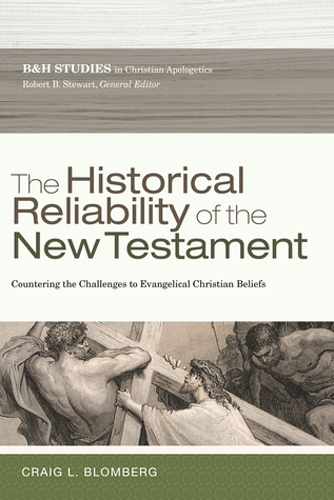
The Historical Reliability of the New Testament: Countering the Challenges to Evangelical Christian Beliefs (B&h Studies in Christian Apologetics)
Questions about the reliability of the New Testament are commonly raised today both by biblical scholars and popular media. Drawing on decades of research, Craig Blomberg...
About BiblicalTraining.org
BiblicalTraining.org wants every Christian to experience a deep and loving relationship with Jesus by understanding the life-changing truths of Scripture. To that end, we provide a high-quality Bible education at three academic levels taught by a wide range of distinguished professors, pastors, authors, and ministry leaders that moves from content to spiritual growth, all at no charge. We are a 501(c)(3) non-profit funded by gifts from our users. We currently have over 180 classes and seminars, 2,300 hours of instruction, registered users from every country in the world, and in the last two years 1.4 million people watched 257 terabytes of videos (11 million lectures).
Our goal is to provide a comprehensive biblical education governed by our Statement of Faith that leads people toward spiritual growth.