Why I Trust My Bible - Lesson 5
Were the Authors Historically Accurate?
In this lesson, you explore the issue of historical accuracy in the Gospels. You examine Darrell Bock's approach to critical scholarship, highlighting multiple attestations of events from different traditions (Mark, Q, M, L, and John), which support the reliability of the Gospel accounts. You review embarrassing and hard sayings of Jesus, arguing that such difficult content would not be fabricated, which reinforces the authenticity of the Gospels. The lesson also discusses missing sayings, indicating that early church debates remained unresolved due to the Gospel writers' commitment to truth. Dr. Mounce concludes by explaining the Gospel writers' dedication to preserving accurate historical records, emphasizing that Christianity’s foundation in historical events necessitates truthful documentation.

1. Challenge
2. Multiple attestation
a. Mark
b. Q
c. L(uke)
d. M(atthew)
e. John
3. Embarrassing Sayings
a. Judas
b. “Get behind me Satan”
4. Hard Sayings of Jesus
a. Luke 14:26
b. Mark 13:32
c. Conclusion
5. Missing Sayings
a. Circumcision
b. Speaking in Tongues
6. Would the Gospel writers have even wanted to preserve accurate history
a. Challenge
b. Gospel is grounded in historical fact (e.g., the Holocaust)
7. Conclusions
a. Can you “prove” the writers were accurate?
b. Are there indications they wanted to be accurate?
c. Are there indications they were successful in being accurate?
d. How high is the bar?
1. Challenge
In this session, we are going to talk about the whole issue of historical accuracy. Were the Gospel writers historically accurate, or even maybe more importantly, was it even important to them to be historically accurate? All right, so historical accuracy. Darrell Bock spends quite a bit of time on this topic, and it gets a little technical, but I’m going to just give you some of the basics. If you want more, make sure to go check out his seminar. But what he does is that he looks at the rules that critical scholarship uses to decide whether they think this verse belongs in the Bible or not, did Jesus really say it or not. And he takes those rules and he kind of flips them on their head, and he shows how even using the rules of critical scholarship, you can still prove that a lot of what’s in the Bible is true. And again, he’s very quick to say, just because you can’t prove something doesn’t mean it isn’t true. We’ve talked about that. Even if you can’t prove to a liberal critical scholar that this verse belongs in the Bible, it doesn’t mean that it's made up. You just may not be able to prove it to their satisfaction.
2. Multiple Attestations
So, what are the rules, what are some of the things we look at to determine whether the writing is historically accurate? And the first place that Darrell goes is to a rule called ‘multiple attestation.’ Let me think of a silly example. You go down and get something to eat and you run into a friend, and they say “Hey, did you hear this happen?” Well, the fact that your friend said it to you probably suggests that it did happen. But then you see another friend, then another friend, and another friend, and they’re all saying the same thing. See, as you hear the same story being told by totally different people, it increases the likelihood that what they’re saying is true. Make sense? All right. The same thing happens in the Gospels, that if you have different streams of tradition (again, when I use the word ‘tradition’ it doesn’t mean that I don’t believe it, it’s just the word we use), that we have different streams of tradition, the more you have, the more you can ‘argue’ within the context of critical scholarship that that actually happened, that it’s true.
So, when it comes to the Gospels, what we have is about five different streams, multiple attestation, about five different streams of tradition. And the first is Mark. We believe that Mark was the first Gospel written, memoirs of Peter. And so, we read stuff in Mark and so we learned what Jesus did and what Jesus said.
There’s another, and you can use the word ‘document’ (it’s not the best word), but there’s another document called ‘Q.’ It’s a German word ‘quelle’ which means source. So we get ‘Q’ from it, and what ‘Q’ appears to have been was a collection of teachings of Jesus. And we don’t have ‘Q’ anymore. It’s a hypothetical thing. But the reason we believe there was is that you can go to Matthew and Luke and read the same story that’s not in Mark, and they’re often word for word the same. In other words, it really looks like in some places Matthew and Luke were citing another source. And we call that ‘Q.’ So, Matthew and Luke had Mark, and they used Mark. Almost all of Mark is in Matthew and Luke. And then there was this ‘Q’ document that occurs in both Matthew and Luke, and because it’s in Matthew and Luke, apparently there was no reason to keep it. And so, it was not continued to be copied and used.
But then there also is other traditions that we call ‘M.’ And ‘M’ are information about Jesus that is only found in Matthew. And then we have a fourth stream of tradition that we cleverly call ‘L’, and this is material that’s only in Luke. So let me summarize that. So, Mark sits down, and he writes his Gospel. That’s the first one. Matthew sits down. He’s got Mark. He’s got ‘Q.’ And he’s got a bunch of his own material. And he puts that stuff together, and you get Matthew. Luke comes along, and he has Mark. He has ‘Q.’ And he has a bunch of his own stuff (we call it ‘L’), and he writes his Gospel. So what you have there are four streams of tradition; four, in terms of multiple attestation, you have four different sources of information about Jesus, And then, of course, you have the Gospel of John. And John is kind of his own man, and he’s writing out of his own personal experiences with Jesus. So, we have all of these five different streams/tradition, multiply attesting many of the same events, and many of the same teachings.
And the example that Darrell uses is Son of Man. Now, there are some Son of Man sayings that emphasize Jesus’ humanity. Or there are some Son of Man sayings that emphasize his coming persecution, his coming suffering. But there’s other Son of Man sayings that talk about him coming as an apocalyptic figure, a divine figure, and judge of the whole world. And what’s interesting is that all three of those are attested to in these various streams of tradition, and yet critical scholarship will accept the first two but not the final. They don’t want to accept the fact that Jesus said he’s the coming Judge of the living and the dead, that he’s going to judge the world. And the argument that Darrell makes is, well, you can’t have it both ways. You can’t accept some of these sayings but not some of the others when they’re all tied together. Again, it’s a slightly technical argument, but it’s a very powerful argument within the scope of scholarship. So, when it comes to asking were the writers historically accurate, when we see the same event being taught multiple times, multiple people, then you can argue there’s a greater chance that it is, in fact, accurate.
3. Embarrassing Sayings
Ok, let’s look at some of the other reasons why we think the Gospel writers cared about being historically accurate, and these are much simpler to process. Embarrassing sayings. Again, the argument is that if the church was willing just to make up sayings ‘willy nilly’, would they have made up these particular sayings because there are things in the Gospels that are just embarrassing to the original audience, to the characters involved in the story. And if the Church doesn’t care about historical accuracy, if it’s willing just to make up stories, would it have made up these stories? The answer you’re going to see is ‘no’, they wouldn’t have made up these stories. For example, Jesus goes out and he picks twelve people to be with him for three and a half years. One of them tried to kill him, Judas. That’s embarrassing. I mean, the Gospel writers are saying that Jesus was the Son of God, that he was here on a divine mission, and yet he chose Judas, someone who tried to kill him. Why on earth would you do that? That’s kind of embarrassing to Jesus that he couldn’t get twelve good people. Or perhaps at Caesarea Philippi when Jesus and Peter had their little altercation, and Jesus says, “I’m going to suffer”, Peter rebukes Jesus, and Jesus says, “get behind me, Satan.” Really, if you were making up the Gospel story, would you take the head of the Church, at least of the Jewish Church (Peter), and would you have Jesus rebuke him and call him Satan? No, that’s embarrassing to Peter. It’s embarrassing that’s he so totally misunderstood the concept of Messiahship and suffering that he rebuked Jesus for saying he was going to suffer, and then got rebuked right back. You wouldn’t make up something like that. And there are quite a few of these embarrassing sayings in the Gospels. And again, the point is: if the Gospel writers were trying to be historically accurate, then this is part of the story and they’re going to record it because it happened. But if you were just making up stories, you wouldn’t make up these kinds of stories. They’re embarrassing.
4. Hard Sayings
Another category that is related to it are what are called the hard sayings of Jesus. In other words, there are things that Jesus says that are really, really difficult to process, that are really open to miscommunicate; and again, if the Church was making all of this up, would you really make up these hard sayings? For example, Luke 14:26, Jesus says, ‘If anyone comes to me and does not hate father and mother, wife and children, brothers and sisters, yes, even their own life; such a person cannot be my disciple.’ Really? Would you have made that up? That’s harsh, that’s hard. Or, how about Mark 13:32 where Jesus says, ‘I don’t even know when the end of time’s going to happen; only God the Father knows when I am going to return again, and time is going to end.’ Really? So, you’re the second member of the Godhead and there is stuff you don’t know? That’s hard. The argument is that these hard sayings are included because the Gospel writers know they happened, and that they are important. If the Gospel writers were only just to make up stories, they would not have made up these hard sayings.
5. Missing Sayings
Again, this is all kind of related. But they’re called the missing sayings. There were debates that happened in the early Church that it would have been so nice if Jesus had just answered the debate. All right? And so, if the Church was willing to make up stories, then they would have made up stories to answer these early debates. But the fact that they didn’t make up answers to some of the early debates indicates that they wanted to be historically accurate. A great example is circumcision. This is the first real debate of the Church; do you have to be a Jew to be a Christian? All right? Do you have to be Jewish first? Do you have to undergo circumcision? And there was a lot of problems. Paul comes back from his first missionary journey. People find out he’s talking to Gentiles; and in Acts 15, they call together the Jerusalem Church and they go through this long story of here’s what Paul and Barnabas say is happening. Peter talks about what happened to him. If the Church was willing to make up things, I suspect that they would have made up a statement where Jesus said, “You don’t have to be circumcised to be one of my followers.” The debate would have gone. It simply wouldn’t have existed. But there is no verse from Jesus like that; ergo, the assumption is, the conclusion is, that the Gospel writers weren’t willing to make up stories. Another interesting example is tongues in 1st Corinthians. There was a lot of problems going on about the whole nature of tongues. And what’s interesting is in 1 Corinthians Paul quotes Jesus quite a bit; and then you come to chapters 12, 13 and 14, and you have Paul trying to set down rules on the speaking of tongues, speaking in unknown languages. And it would have been so easy, since he’s been quoting Jesus all along, to say “Oh, well, you know Jesus said, you know, ‘Two or three and you must have an interpreter.’” He doesn’t do that. He doesn’t say that. Paul wasn’t willing to make up a Jesus saying in order to answer the debate! Understand?
So, when you look at all these different kinds of hard sayings, the missing sayings and the embarrassing sayings, people just don’t make those kinds of statements up. And so, the argument is that they must have actually happened, and the Gospel writers thought it was very important to accurately relay what Jesus did and taught, even if it was embarrassing or difficult.
6. Accurate Historical Preservation
But there is another question, and that is: did the Gospel writers even want to preserve history? Was it important to them at all to preserve accurate history? And the challenge often comes, is that if you really believe something, you’re biased; and that if you really believe something, then you can’t be trusted when it comes to the accuracy of your statement. And there are certainly examples of that being true. If you look at an old Soviet Union encyclopedia, they have one sentence on Jesus, that he was the mythical founder of Christianity. That’s it. They don’t want to believe in him. They are biased against him, and so they just simply change history. All right, so we do know that people will change history because of beliefs. But the question is would the Gospel writers have done that? And is there any evidence that they did it at all? And I think the interesting point on Christianity is that Christianity is grounded in historical fact. All right? This is the point that Luke so beautifully makes in his, in the prologue, “You know, I’ve researched, and I’ve checked my sources, and because, Theophilus, I want you to know the certainty of the things that you have believed.’ In other words, history is a really big thing to Luke. And the question is: why? Well, there’s a lot of religions where if they didn’t historically happen, it wouldn’t matter. I don’t know a whole lot about Confucianism, but I’ve been told that even if Confucius had not lived, it doesn’t affect the truth of the statements in Confucianism. But if Christ had never lived, if our source documents were not historically accurate, if we didn’t know that our faith was grounded in historical fact…well, Paul says (take the Resurrection, for example), he said we’d be the greatest of fools if this didn’t actually happen. The Resurrection had to happen. Jesus had to live. Jesus had to be born, fully human and yet divine. I mean, these things had to have happened, and therefore, it’s because of the nature of Christianity, and the connection that we have with history, and our theology is grounded in the history. It is incredibly important that the Gospel writers, in fact, relayed historically accurate information.
Take, for example, the Holocaust. The people that have told the story of the Holocaust, whether they were eyewitnesses or they were writing about it, did they have to get the history correct? Yes! If Auschwitz did not happen, if their descriptions were not historically accurate, then their witness to the atrocities would be dismissed. And it could happen again. Unfortunately, it could happen again anyway. But you see this in the writings of the Holocaust, is that they understand that if they’re going to stop this from ever happening, people have to know that this actually did occur. And so while they are strongly invested in the Holocaust emotionally (because they’re Jewish and they’re writing about what happened to them and to their parents), even though they’re heavily invested in it in terms of commitment to it, they had to write historically accurate accounts of Auschwitz and the other concentration camps; otherwise it would all have been forgotten. So, the same thing too with Christianity. History is important; the events of Jesus had to have occurred, especially the Resurrection. And so, you see in the Gospels a real desire to relay the facts, the history of it, in a very accurate, believable way. Can you prove it? Can we prove that they are historically accurate? No! But are there good indications that they wanted to be accurate? Yes! Are there good indications that they were successful? Absolutely! Just ask the archeologists. Just ask how many archeological finds have disproven Christianity, and the answer is none, none, not a single one! William Ramsey was a famous archeologist that set out to disprove the Bible, and he was going to do it through archeology. And as he continued to unearth 1st century ruins, biblical ruins, Christian stuff, he became absolutely convinced (and became a Christian) that the Gospel was true because it was so historically accurate. So yeah, the Gospel writers had to be historically accurate. There’s indications that they tried (just read Luke 1:1-4). There are good indications that they were successful (just check with an archeologist). Now, can you absolutely prove it to everyone’s satisfaction? Of course not! But a question’s how high is that bar? And even if you put the bar up pretty high, the Bible has shown itself, time after time after time, to be a very accurate, historical document.
7. Conclusions
So that’s the issue on historical reliability of the Bible. The Gospel writers wanted to be accurate, and there is every indication that they were accurate. They’re not going to be making up stories. They’re going to be relaying what they knew Jesus did and what Jesus said.
- Some people feel that it is wrong to ask fundamental questions such as whether or not they trust the Bible. But if you never seriously ask the question, you will never be convinced that it really is true and trustworthy.0% Complete
- Some question whether Jesus actually lived, claiming there's only one non-biblical reference. This is false; there are many more.0% Complete
- Learn about the reliability of the New Testament through oral tradition, the impact of Jewish oral culture, three approaches to orality, memorization techniques, corporate memory, scholarly presuppositions, the Holy Spirit's role, and the delayed documentation of the Gospels.0% Complete
- While the gospels are anonymous, tradition is very strong as to who wrote Matthew, Mark, Luke, and John, and all four authors were in a position to know the truth and we can trust their writings. If the church did not care about authorship traditions, they would not have picked these four.0% Complete
- If the biblical writers were not concerned about historical accuracy, we would expect more verses that would have answered the burning questions of the first century, and we certainly would not have the many embarrassing and difficult verses that we do have. The gospel is couched in historical fact, and if the events did not happen then the teaching is false.0% Complete
- Learn how to address perceived contradictions in the Bible by understanding harmonization, interpretation, and considering possible errors in secular sources, all while encouraging a trust in the Bible’s reliability.0% Complete
- Investigate whether Paul changed Jesus’ message. Despite different contexts and approaches, Jesus' and Paul's teachings align on core theological issues like justification by faith and ritual purity, affirming their compatibility.0% Complete
- Learn why trusting the Bible is rational despite the inability to prove it, and you'll gain tools to ask questions, strengthen your faith, encourage others, and counter opposing views with sound biblical doctrine.0% Complete
It does no good to talk about inspiration and canonization if the church altered the contents of the Bible through the centuries. And why are there differences among the Greek manuscripts? This is the topic of textual criticism. The current situation is that we are confident of 99% of the New Testament text, and the 1% we are unsure of contains no significant theological doctrine.
0% CompleteUnless you can read Greek, Hebrew, and Aramaic, you need a translation. But why are there so many, and why are they so often different? Can they be trusted? Bill Mounce, chair of the ESV translation for 10 years and currently on the Committee on Bible Translation that is responsible for the NIV, shares his answer to these questions.
0% Complete- Dr. Mounce shares personally why he trusts his Bible.0% Complete
Lessons
- Some people feel that it is wrong to ask fundamental questions such as whether or not they trust the Bible. But if you never seriously ask the question, you will never be convinced that it really is true and trustworthy.0% Complete
- Some question whether Jesus actually lived, claiming there's only one non-biblical reference. This is false; there are many more.0% Complete
- Learn about the reliability of the New Testament through oral tradition, the impact of Jewish oral culture, three approaches to orality, memorization techniques, corporate memory, scholarly presuppositions, the Holy Spirit's role, and the delayed documentation of the Gospels.0% Complete
- While the gospels are anonymous, tradition is very strong as to who wrote Matthew, Mark, Luke, and John, and all four authors were in a position to know the truth and we can trust their writings. If the church did not care about authorship traditions, they would not have picked these four.0% Complete
- If the biblical writers were not concerned about historical accuracy, we would expect more verses that would have answered the burning questions of the first century, and we certainly would not have the many embarrassing and difficult verses that we do have. The gospel is couched in historical fact, and if the events did not happen then the teaching is false.0% Complete
- Learn how to address perceived contradictions in the Bible by understanding harmonization, interpretation, and considering possible errors in secular sources, all while encouraging a trust in the Bible’s reliability.0% Complete
- Investigate whether Paul changed Jesus’ message. Despite different contexts and approaches, Jesus' and Paul's teachings align on core theological issues like justification by faith and ritual purity, affirming their compatibility.0% Complete
- Learn why trusting the Bible is rational despite the inability to prove it, and you'll gain tools to ask questions, strengthen your faith, encourage others, and counter opposing views with sound biblical doctrine.0% Complete
It does no good to talk about inspiration and canonization if the church altered the contents of the Bible through the centuries. And why are there differences among the Greek manuscripts? This is the topic of textual criticism. The current situation is that we are confident of 99% of the New Testament text, and the 1% we are unsure of contains no significant theological doctrine.
0% CompleteUnless you can read Greek, Hebrew, and Aramaic, you need a translation. But why are there so many, and why are they so often different? Can they be trusted? Bill Mounce, chair of the ESV translation for 10 years and currently on the Committee on Bible Translation that is responsible for the NIV, shares his answer to these questions.
0% Complete- Dr. Mounce shares personally why he trusts his Bible.0% Complete
Class Resources
Recommended Books
Why I Trust My Bible - Student Guide
We can no longer assume that people trust their Bible. The popular media has launched such an attack on the believability of Scripture that our people have serious questions...

Why I Trust The Bible
Answers to Real Questions and Doubts People Have about the Bible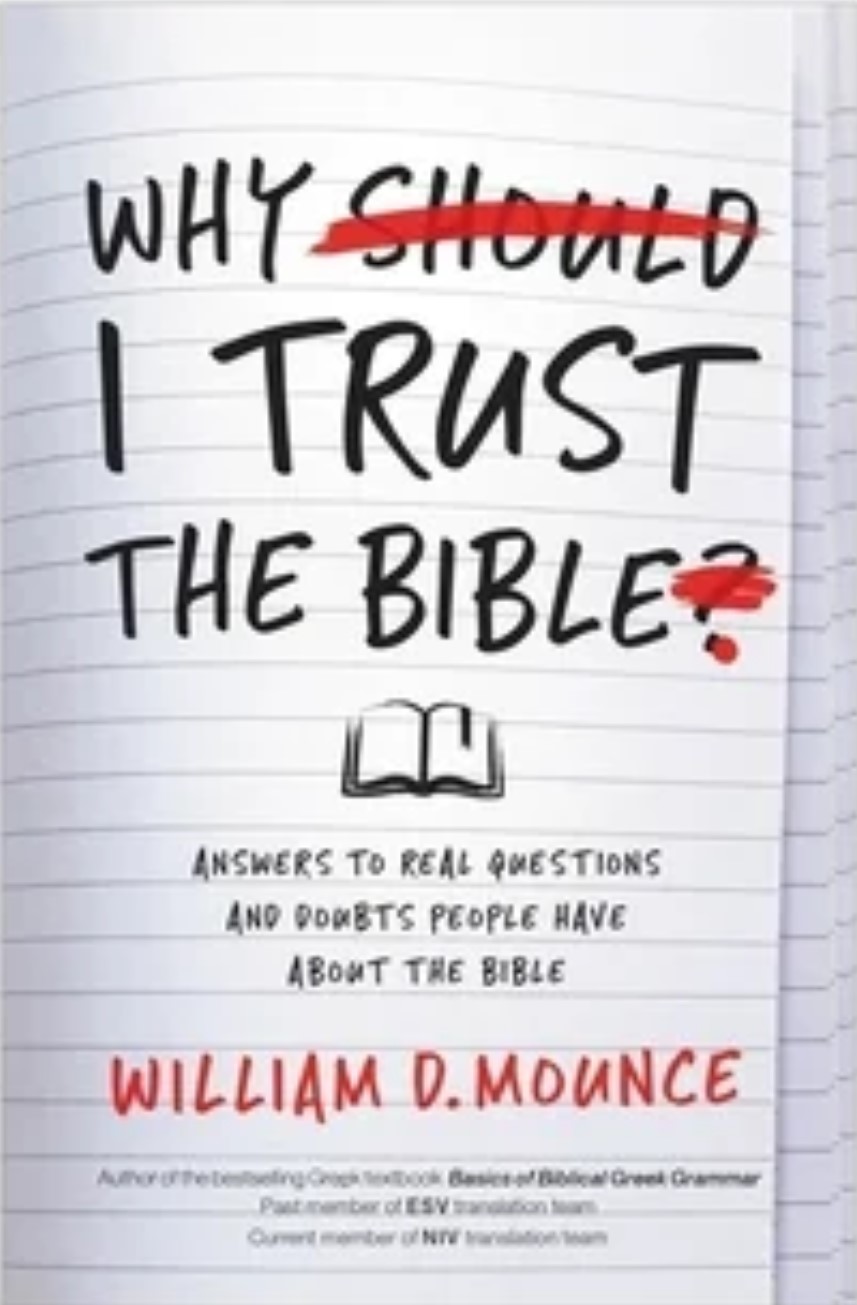
Downloads
Recommended Readings
Links
About BiblicalTraining.org
BiblicalTraining.org wants every Christian to experience a deep and loving relationship with Jesus by understanding the life-changing truths of Scripture. To that end, we provide a high-quality Bible education at three academic levels taught by a wide range of distinguished professors, pastors, authors, and ministry leaders that moves from content to spiritual growth, all at no charge. We are a 501(c)(3) non-profit funded by gifts from our users. We currently have over 180 classes and seminars, 2,300 hours of instruction, registered users from every country in the world, and in the last two years 1.4 million people watched 257 terabytes of videos (11 million lectures).
Our goal is to provide a comprehensive biblical education governed by our Statement of Faith that leads people toward spiritual growth.