Why I Trust My Bible - Lesson 8
Canonicity: Why We Have the Books We Do?
Canonization is the process by which the church determined what books belonged in the Bible (and here we are focusing on the New Testament). Despite the frequent assertion to the opposite, the canon was not determined by a few individuals in a haphazard way. It appears that the three tests were authorship, harmony of doctrine and tone, and usage in the church as a whole. Did the church get it right?

1. Challenge
a. Ehrman, Lost Scriptures: Books that Did Not Make It into the New Testament
b. Dan Brown and the Davinci Code
2. Definitions
a. “Canon”
b. “Canon”
c. “Canonicity”
3. Two Issues
a. Hebrew canon (OT Apocrypha)
b. New Testament canon (NT Apocrypha and the Pseudepigrapha)
4. Old Testament Apocrypha
a. “Apocrypha”
1) Etymology means “hidden”
2) Jerome: books suitable for reading in the church ( “ecclesiastical books”) but not suitable for establishing doctrine (“canonical books”)
b. Characteristics
1) Some written in Hebrew, but mostly in Greek
2) Written after Malachi (300 B.C. to 100 A.D.)
3) Never accepted by Judaism or Jesus
c. History
1) Part of the LXX
2) Early Church writers viewed them as of secondary significance
3) Jerome included them in the Vulgate and hence the KJV 1611
d. Reformation (1400’s)
1) Luther
2) Publishers
3) Today
e. Jews
1) Believed Malachi to be the last prophet
2) Closed their canon around 90 A.D. (vs. Christians)
5. New Testament canon
a. Challenge
1) Decided by some Council
2) Took 400 years to complete
b. Problem developed
1) Death of eyewitnesses and apostles
2) Persecution
3) Heresy and false writings
c. Process of Canonization
1) A new covenant needs new authoritative documents
2) NT awareness of a new “canon” (2 Peter 3:15–16; 1 Timothy 5:18)
3) Citations from early Church Fathers
d. Two basic definitions of “canon”
1) Extrinsic (external): list of books the church determined to be authoritative
2) Intrinsic: books are authoritative, and are recognized as such by the church
e. Description of the omitted books
1) Written in 2-3 century A.D.
2) Not accepted by the church as a whole
3) Often disagree with the teachings of the NT canonical books
f. Three criteria of authenticity
1) Apostolic authorship (“Apostolicity”)
a) Written by an apostle or a close associate of an apostle
b) Seen in how the later church leaders refer to the apostles and their writings
c) Seen in how the church handled some orthodox but non-apostolic writings
d) Seen in how the church handled forgeries
2) Harmony of doctrine and tone (“Orthodoxy”)
a) Most books not in the canon do not agree with the canon
b) Example of the Gospel of Thomas (Saying 114)
c) Infancy Gospel of Thomas
3) Continual usage in the church as a whole (“Catholicity”)
a) Canonicity not determined by a group of church leaders
b) Church as a whole recognized the inherent authority
g. Did any canonical books struggle to be recognized as canonical?
1) No
a) Paul
b) Apostolic writings (Matthew, Mark)
c) Luke/Acts
2) Hesitancy
a) John
b) Hebrew
c) James
d) 2 Peter
e) Philemon and 2/3 John
f) Jude
g) Revelation
3) Lists
a) Muratorian Canon
b) Irenaeus
c) Tertullian
d) Origen
e) Councils
h. Conclusion
1) Have you read them?
2) Do they pass the three-fold test?
3) Decision was made by the church as a whole
1. Challenge
In this session we’re going to look at the whole issue of what is called ‘canonicity.’ canonicity is basically the whole discussion of why we do have the books in the Bible that we do, and why don’t we have others. The challenge, again, has most recently come from Bart Ehrman. His book is called Lost Scriptures, Books that Did Not Make It into the New Testament. But even on a more popular level, we have Dan Block’s [recte Brown’s] book, The Da Vinci Code; both questioning why we have the books in the Bible that we have. You know, Block’s [recte Brown’s] book is pretty interesting. He claims that the Council of Nicaea, which is 325 AD, was about Constantine and his control over the Canon. And even though it is ’a novel,’ as he himself says ’it is a novel,’ there are some university professors teaching The Da Vinci Code as fact. Well, the fact of the matter (let’s get this straightened up right at the beginning), the fact of the matter is that the Council of Nicaea had nothing to do with the Canon. The Council of Nicaea was about Arianism, about the divinity of Christ, and about the relationship between God the Father and God the Son. So, this whole idea of the Council of Nicaea and Constantine’s role being involved in the issue of canonicity is simply completely made up, not an ounce of truth to it at all. But anyway, but that is the challenge.
2. Definitions
Let’s start with a couple of definitions. What is the Canon? The word ‘Canon’ refers to a standard, the guide by which you decide whether something’s true or false. Alright? So, when we talk about the ‘Canon of the Bible,’ we’re talking about the collection of the books that are received… This is Bruce Metzger’s definition, “The collection of books which are received as divinely inspired and therefore are authoritative for faith and life.” So that’s the Canon, the actual books, and canonicity is the study of why we have the books in the Canon that we do, and why others were left out.
3. Two Issues – Hebrew Canon and New Testament Canon
There’s actually two issues when it comes to canonicity. I want to make sure we split these in two. The first is the Hebrew Canon, and the issue there is the Old Testament Apocrypha; and then there’s the issue of the New Testament Canon, and the issues there are with the New Testament Apocrypha and something called the Pseudepigrapha. So, we’re going to look at those two different issues.
On the class site, there’s a download of the Old Testament Apocryphal books, and so if you want to see them. And what you’ll see is that there’s twelve books in the Roman Catholic Canon that are not in the Protestant Canon. And if you look at the Greek Orthodox Church’s Canon, the list is a little longer than that. But in the Roman Catholic Canon we have books like Tobit, Judith, Additions to Esther, Wisdom of Solomon, Ecclesiasticus, Baruch, the Epistle to Jeremiah, the Song of the Three Children, the Story of Susanna, Bel and the Dragon, 1st and 2nd Maccabees; those are all books that are in the Roman Catholic Canon that are not in the Protestant Canon.
4. The Old Testament Apocrypha
a. Apocrypha
Okay, so what’s going on? First of all, let’s just start with the word ‘Apocrypha.’ What does the word ‘Apocrypha’ mean? Well, etymologically, the word ‘Apocrypha’ means ‘hidden.’ And unfortunately, it is used today sometimes to refer to something that’s inauthentic, but that’s actually not what the word originally meant. Jerome used the word Apocrypha to describe books that were suitable for reading in the church but not suitable for determining doctrine. And that’s a really important distinction that we see for the first 1500 years of the church, that these books were viewed by some people as good to read. They’re a good story; they have ethical values (usually), but not using them for determining doctrine, determining what we believe. So that’s what the word Apocrypha means; hidden in the sense that they should not be used for doctrine.
b. Characteristics
As you look at these twelve books, there are some basic characteristics. While some were written in Hebrew, most of them were written in Greek, which makes it different from the Old Testament which is in Hebrew and a little bit in Aramaic. They were all written after Malachi. Malachi, the last prophet in the Old Testament, is 4th century. And these Old Testament Apocryphal books were written between 300 BC and 100 AD. So, they were really written in a different time frame than the rest of the books in the Hebrew Scriptures. And the Old Testament Apocrypha was never accepted by Judaism. They never accepted any of these books into their Canon. And interestingly, Jesus doesn’t quote from them either. He quotes from the Old Testament, but he doesn’t quote from the Old Testament Apocryphal books.
c. History
Well, what happened, in terms of history, is that when the Old Testament was translated into Greek, (we call it the Septuagint, sometimes referred to with the Roman numbers LXX). When the LXX (the Septuagint) came along, it did have the Apocryphal books. And so probably the Bible that Paul carried, (if he carried a Bible; certainly, the Bible that he would have used), would have been the Septuagint which means he’s had at least these twelve extra books in them. As you look at church history though, like I said, the church leaders understood that these twelve books were secondary. There was something that was different about them; read them for ethics, don’t read them for theology (stuff basically like that). And when you get up to the time of Jerome. Jerome wrote the Latin Vulgate which is hands down the most dominant translation in history, even exerting much more influence than the King James did. But when Jerome came along, he was forced to include the Apocrypha in the Latin Vulgate, and hence it went from the Latin Vulgate into the 1611 King James. That’s how they got into the English Bible. It’s interesting, though, this is what Jerome said about them: he said the Old Testament Apocrypha are “an example of life and instruction of manners, but yet doth it not apply them to establish any doctrine.” Okay, old English, but the point is that–read them, it’s okay to read them. Just don’t determine any theology from them. Bruce in his book, The Books in the Parchment, tells the story of how Jerome didn’t even want to include them, but he was kind of tricked into it. So that’s through the history not accepted by the Jews, in the Septuagint of secondary significance, got into the Vulgate and therefore, got into the King James.
d. Reformation
Well, what happened though to counter that was the Reformation. The Reformation was roughly 1400s, and Luther didn’t like some of the doctrines that the Catholic Church said came out of the Apocrypha, the doctrines of baptism of the dead, the doctrine of indulgences (supposedly their Biblical basis were in some of the Old Testament Apocryphal books). And Luther didn’t like the doctrines, and he didn’t like the books. And Luther wanted to return to the Greek and the Hebrew. And the Renaissance had started in the 1300s, and part of the Renaissance worldwide was to (at least in that area of the world, I should say), part of the emphasis, the Renaissance, was to go back to Greek and Hebrew in general. And so, between that and Luther’s view of Greek and Hebrew, there’s a real suspicion of these Old Testament Apocryphal books.
So, what happened? The Coverdale Bible in 1535 was the first Bible to take the Old Testament Apocryphal books and move them to a section between the Old and the New Testament. In the Vulgate and the Septuagint, they were interspersed throughout all the Old Testament books, chronologically where they belong. What happened in the Coverdale Bible is they were taken out and they were put into a separate section, and then within about a hundred years, for the most part, publishers had completely dropped out the Old Testament Apocryphal books. And again, if you want to read the details of all that, in F.F. Bruce’s book he talks about them.
e. Jews
As far as the Jews were concerned, they never accepted them. And probably in response to Christianity, the Jews appeared to have closed their Canon about 90-95 AD. And so, they didn’t want Christian writings, or anything else, to get into their Canon. And so, you had the Jewish people never ever accepted these books. So, that’s a real brief overview of the Old Testament Canon, the Old Testament Apocryphal books, and why they are around but not included any longer in the Protestant Bible.
5. New Testament Canon
a. Challenge
So, we’re going to turn our attention now to the New Testament Canon. And the challenge to the New Testament Canon goes something like this: the New Testament Canon, what books we included in the New Testament, which ones we left out, that decision was made by some council or councils, church leaders’ kind of off in the corner by themselves. And it took them 400 years, they’ll say, to really make their decisions. So, given how it was made and how long it took to be made, why do you trust their decision? Now one of the interesting quick comebacks is (we’ll talk about these councils that made these decisions), the fact of the matter is there was no council that formally met to determine issues of Canon until the Council of Trent in the 1500s in the Counter-Reformation. And the Council of Trent met, among other things, to finally, officially establish the Old Testament Apocrypha as being part of the Bible. So there never was a council whose major purpose was to meet and decide what books belong in the New Testament. So, you can start with that. Let’s go through historically what’s going on.
b. Problem Developed
Problems started to develop, and they developed for several reasons. As the church got a little older in the 1st century, you started having the eyewitnesses and the Apostles die. In other words, the church lost the people who were exerting control over what Christianity was, and what we believed, and that kind of stuff. So, you had the death of eyewitnesses and the Apostles. Secondly, you had the rise of persecution. There was a point in time where it was a capital offense to even own a book of the Bible. But you had this growth of persecution that made people want to be really sure and really careful that, “Okay, these are the books that we accept, and these are the teachings that we accept because I don’t want to die for something that’s not true.” So, you had the rise of persecution. And thirdly, you had the rise of heresy and false writings. Now you already get a little bit of that in the New Testament itself. For example, Paul tells the Thessalonians in 2nd Thessalonians 2:2 that they may have received a false letter that “the Day of the Lord has come.” Someone wrote a false letter to the Thessalonian church saying that Christ’s return has already happened. You see later on in Galatians in 6:11, Paul says, “See with what large letters I’m writing, that’s how I sign all of my books.” Apparently, it was his signature of authenticity, because the assumption is people were forging letters supposedly from Paul. And then you had the whole rise of Gnosticism in the 2nd century and other heresies. So, you had this problem start to develop as to what books should we accept, which books shouldn’t we accept. And so there was a process of Canonization that started, and actually the process started in the Old Testament.
c. Process of Canonization
There is a covenant in the Old Testament, and there are documents supporting and defining that covenant. You then have the prophecy of the New Covenant, so there’s going to be an expectation that with the New Covenant there’s going to be a new set of authoritative documents to define it. So, you have built into the Old Testament the concept of a Canon being created for this New Covenant. Also, even in the New Testament itself, you have the realization that a new Canon is being created. And the most important verse is in 2nd Peter 3:15-16, let me just read it, Peter writes, “Bear in mind that our Lord’s patience means salvation, just as our dear brother Paul also wrote you with the wisdom that God gave him. He writes the same way in all his letters speaking in them of these matters. His letters contain some things that are hard to understand, which ignorant and unstable people distort (and then here’s the important point), as they do the other Scriptures to their own destruction.” So, Peter died in the late 60s according to church tradition, and so even by his time he was starting to realize that Paul’s writings were on par with the Old Testament writings, and hence this development of this New Testament Canon. You also have an interesting comment of Paul’s in 2nd Timothy 5:18. Paul is arguing that leaders of the church should be paid, and he says, “For Scripture says (and that’s the important point), for Scripture says do not muzzle an ox that is treading out the grain, and worthy is the worker of his wage.” Well, the first quotation is from Deuteronomy 25:4 (that’s no trouble; Scripture says Deuteronomy 25). But the second is actually a citation from Luke 22 which has interesting ramifications for the dating of Luke, that Luke had to have written for Paul to quote him. But the point is that Paul says, “Scripture says,” and he quotes not only Deuteronomy, but Luke. So again, you have the beginning of this concept that there is a new Canon being created to go along with the New Covenant. You can also see it in the early church fathers as they quote the New Testament writings authoritatively, and hence we have this whole creation of a New Testament Canon.
d & e. Omitted Books and Basic Definitions of Canon
So that’s part of the process, and then into the mix you have these other books that are thrown. And let me just give you a very general description of what these other books that have been left out of the Canon were like. Number one, they were all written in the 2nd to 3rd century, perhaps even later than that; they’re not 1st century writing. The Gospel of Thomas and these different books, they weren’t written in the1st Century. They were written in the 2nd to 3rd Century. So, when they say that Thomas wrote it, or you know, the Acts of Paul and Thecla, or something about Peter, none of those people were alive in the 2nd Century. So, we know that their authorship is suspect. Second of all, these books were never accepted as authoritative by the church as a whole. Okay, maybe a little group here or a little group there. But the church as a whole never accepted (again, picking the Gospel of Thomas), never accepted the Gospel of Thomas. It simply wasn’t accepted by the church. And thirdly, these books often disagree. Sometimes they don’t, but they often disagree with the books we have already accepted as authoritative. And I’m going to give you some examples of that in a bit.
So, these omitted books, 2nd and 3rd Century, not accepted by the church as a whole, and often disagree with the books that we have accepted as being authoritative. So, what are you going to do with these books? Well, let me take a step back, though, and let me define two other terms that are very important in this discussion. And this book by Michael Kruger, The Question of Canon, does a lot of discussion of this point and is very helpful. If you define a Canon as something that’s extrinsic, something that is external, what that means is that Canon then is a list of the books that the church determined would be authoritative. In other words, the power is not in the New Testament books. The power is in the church, and the church decrees this book is authoritative, and this book is authoritative. If that’s your definition of Canon, then, yeah, the Canon wasn’t closed until end of the 4th Century.
Okay. But there’s another way to look at Canon, and that is an intrinsic definition, it’s often called an ‘ontological Canon’ or ‘internal Canon.’ But the intrinsic view of Canon is that the books are intrinsically authoritative, and the church’s role is to recognize the books’ intrinsic authority. In other words, the question is did the church confer authority on Matthew, or did Matthew inherently process authority and the church simply recognized it? Now, if you accept this definition of Canon, then the books were Canonical as soon as they were written. As soon as Matthew was written it was intrinsically, inherently authoritative, and the church recognized it as such. So, in discussion of Canon, and what we’re going to do with these books that are not in the Canon, it’s important to know whether you accept an extrinsic or an intrinsic understanding of the Canon. And I really think that the intrinsic definition is right. I mean, in a very real sense, the original Canon is Jesus, right? And so, anything that he says or does is authoritative, and so the books that write about what Jesus said and did are intrinsically authoritative because they were a reflection of Jesus, and then the church recognizes it as such. So, if you follow the intrinsic Canon definition, then you see the Canon was formed much more before the end of the 4th Century. The Canon was formed as soon as the books were written, and then the church’s job was simply to recognize their inherent authority.
f. Three Criteria of Authenticity
Okay, so we have our definitions of Canon down. And we have the problem that gave rise to it, the death, the persecution, false teachings. And we have the description of the books that were not included in the Canon. Okay, so let’s put it all together. How did the church determine which books were authoritative? There appears to have been three basic tests. Now, these were never written down anywhere, but as we look at what the church writers say about the different Biblical books, we can see there’s three things going on in the decision-making process. The first is the whole issue of Apostolicity. In other words, did an Apostle or an associate of an Apostle write it? Authorship was a really big deal when it comes to canonicity. The church understood the Apostles had the authority of Christ. There’s no question about that. The church accepted Matthew’s authority, accepted Paul’s authority, accepted John’s authority. Okay, they understood the authority of the Apostles. And therefore, anything that they wrote bears their personal authority. Right? Okay, so the issue of who wrote it is really important in determining what books belong in the Canon. We can see this kind of ripple down through different questions you might ask historically. One question is how did the later church leaders refer to the Apostles? How did the early church leaders refer to their writings? One of the first ones is Polycarp. Polycarp was a bishop of Smyrna, turn of the 1st century. And he actually knew John personally, which is a neat connection. And when he quotes Paul, he says that it’s Scripture. Okay, he understood that Paul has the authority of Christ, and therefore Paul’s writings bear his authority, and therefore Paul’s writings are Scripture.
Kruger, in the book on The Question of Canon, pages 68 and following, gives a lot of details. Let me just summarize briefly. First, Clement 47, Clement says (Clement died about 95 AD) that God sent Christ and Christ sent the Apostles. There’s a direct connection between God and Christ and the Apostles. Ignatius (died about 110 AD) says that the Apostles are the mouthpiece of Christ. Justice Martyr (died around 165 AD): “The Apostles were sent by God.” Irenaeus (died about 202 AD) said the Apostles handed down the Gospel “in the Scriptures to be the ground and pillar of our faith.” In other words, when you look at those citations and others, you recognize that the early church clearly understood the Apostles to carry Christ’s authority, and therefore their writings carried Christ’s authority. And therefore, if they wrote it, their writings needed to be included in the Canon. Make sense? Okay.
So, we can see this whole issue of Apostolic authority and authorship are reflected in the writings of the early church leaders. It’s interesting though, too, to look at what the early church leaders said about orthodox but non-Apostolic writings. In other words, some of these books that are not in the New Testament, like the Shepherd of Hermas and the Didache, are good books. They’re fun to read. There’s nothing wrong in them, and they completely agree with the Bible, but they weren’t written by Apostles and the church uniformly left them out of the Canon. They understood that because of authorship issues, they did not possess the authority that the Canonical books needed to possess. On this whole issue of authorship, you can also see it when it comes to: how did the church handle forgeries? Okay, when the church found a book that claimed to be written by an Apostle, but they knew it wasn’t, what do they do with them? They uniformly rejected them. Alright?
So when a book claims to be written by an Apostle, and the church knows that it wasn’t written by an Apostle, every single one of them was rejected. That’s really an important point. There was a letter to the Laodiceans (Paul makes reference to it, and so someone wrote one). And the Muratorian Canon says that the letter to the Laodiceans (New Testament Apocryphal book) is good to read but it isn’t Scripture since it was written “in our time.” So, they understood that it was written 2nd Century, that it wasn’t written by an Apostle. So, it was rejected. 3rd Corinthians was another Apocryphal book that was written out of love for Paul, and yet when it was discovered that it was a forgery, not only was the book removed from discussion, but the man who wrote it was removed from his church office, because you don’t forge letters and claim that they are from the Apostles. Okay? So, you can see that authorship, Apostolicity, is a really important criteria the church used for determining whether a book should belong in the Canon or not. Okay, that’s the first.
The second test is Orthodoxy; in other words, does the book agree with the doctrine, and I would say even the tone of the books that we have already accepted, as authoritative? And a lot of these books that some people say need to belong in the Bible, all you need to do is read them and you can see why they’re not. And they’re not in there because they don’t agree with the rest of the Canon. Even if they don’t teach heresy, there’s something that’s wrong with them. This is from the Infancy Story of Thomas. It’s about Jesus, and it says (I’ll just read a couple paragraphs), “Now after some days, Jesus was playing in the upper story of a house and one of the children who were playing with him fell down from the house and died. And when the other children saw it, they fled and Jesus remained alone. And the parents of him that was dead came and accused him of having thrown him down. (So, they accused Jesus of killing their child). Jesus replied, ‘I did not throw him down.’ But they continued to revile him. Then Jesus leapt down from the roof and stood by the body of the child and cried with a loud voice, ‘Zenon’ for that was his name, arise and tell me, did I throw you down? And Zenon arose at once and said, ‘No Lord, you did not throw me down, but raised me up.’ Now when they saw it, they were amazed, and the parents of the child glorified God for the miracle that had happened, and worshiped Jesus.” Now, does that sound at all like it belongs in the Bible? Jesus is a little kid, leaping off roof tops, raising children from the dead so he’s not accused of killing the kid. It doesn’t sound like it fits at all, does it?
Here’s actually my favorite (speaking of Joseph), “Jesus’ father was a carpenter and made at that time plows and yokes. He received an order from a rich man to make a bed for him, but when one beam was shorter than its corresponding one, and they did not know what to do. The child Jesus said to his father, Joseph, ‘Put down the two pieces of wood and make them even from the middle to one end.’ Joseph did as the child told him, and Jesus stood at the other end and took hold of the shorter piece of wood, and stretching it, made it equal with the other.” Alright, so is Jesus in the business of making up for Joseph’s mismeasurement of wood and stretching wood out? You know, you want to talk about something that disagrees with tone? Those stories, they just don’t fit, do they?
I’m going to give you an example in a little bit of one of these books that’s been left out of the Canon that differs when it comes to the actual Orthodoxy to Theology. But I want to give you a couple of examples of how one of the criteria seems to be: does this book agree or disagree with not only the Theology, but the tone of the New Testament?
The third criteria is Catholicity, and I don’t mean part of the Roman Catholic Church, but Catholic in the older sense of being worldwide. Was the book used by the church as a whole (Catholicity)? See, it was not individuals that recognized the canonical books. It was the church as a whole recognized the canonical books. And again, as I said, the only council that formally met to determine Canon issues was Trent, 1500s, Old Testament Apocrypha. But rather the church’s role as a whole was to recognize the inherent authority of canonical books. So those are your three tests: who wrote it, Apostolicity; does it agree with what we have already accepted in doctrine and tone, in regards to Orthodoxy; and was it used in the church as a whole, Catholicity. Those seem to be the three criteria that the church used in determining whether a book belongs in the Canon.
Now, let me give you a test case here; there’s always a lot of talk about the Gospel of Thomas. And let me just use it as a test case to see how those three criteria work. In terms of description, the Gospel of Thomas is part of what’s called the Nag Hammadi Library. It’s a library that was discovered in Egypt (okay, that’s the first point). We only discovered it a while back. It wasn’t used by the church as a whole. It got buried in the sands of Egypt, and not used by the church as a whole. So, it fails the test of Catholicity. Second of all, the Gospel of Thomas is a 114 sayings in Coptic dated about 175-180 AD. Okay, it fails the second test of Apostolicity. The Apostle Thomas could not have written it unless he was 180 years old or thereabouts. And thirdly, the Gospel of Thomas is Gnostic. It’s a heretical belief and hence fails the other test of Orthodoxy. Okay, so the Gospel of Thomas fails at all three tests.
Let me read you the last of the 114 sayings, and ask yourself (and I’m thinking here more in the issue of Orthodoxy), ask yourself: should this be in the Bible? “Simon Peter said to them (meaning the Apostles), ‘Let Mary leave us, because women are not worthy of life.’” Jesus apparently appears, or something, and Jesus says, “Look, I shall lead her so that I will make her male in order that she also may become a living spirit (see, as a female, she’s not a living spirit) resembling you males. For every woman who makes herself male will enter the Kingdom of Heaven.” Now, this takes misogyny to a whole new level, doesn’t it? Okay. Should that be in the Bible? Of course not, of course not! See, the fact of the matter is the vast majority of people that want to include the Gospel of Thomas in the Bible have never read it. Because you can’t read that and think it belongs in the Bible. Obviously, it doesn’t. But it’s interesting that in the Jesus Seminar that came along and was determining what verses of the Gospels they thought belonged in the Bible and which ones don’t, actually published their New Testament with five Gospels: Mathew, Mark, Luke, John and the Gospel of Thomas. And they thought that a higher percentage of Gospel of Thomas was authentic than they did of any of the other Gospels. So those are the tests of canonicity and using Gospel of Thomas as a test case.
g. Canonical books that struggled to be part of the Canon
Did any Canonical books struggle to get into the Canon? Yeah, yeah, they did, a few of them. Now, when Paul wrote, his letters were accepted as authoritative by the church as a whole, instantly; no delay. They were recognized as being the writings of an Apostle bearing Paul’s authority, and therefore his books were authoritative and as we called them, Canonical. Other Apostolic writings were accepted immediately. Matthew was accepted immediately into the Canon. Mark was actually accepted immediately into the Canon. Mark wasn’t an Apostle, but according to reliable church tradition, Mark wrote the memoirs of Peter. So, Peter, as an Apostle, his authority lies behind Mark, and so it was accepted right away. Interestingly, both Luke and Acts were accepted instantly into the Canon, even though Luke was not an eyewitness, even though he was not an Apostle, the church understood that what he was writing as a friend of Paul’s was authoritative and accepted. There was some hesitancy for some period of time on some of the other books. The Gospel of John was used by the Gnostics, the heretics, and people were a little suspect of “Well, should we really use this fourth Gospel since those heretics are using it?” And I’ll speak because it is different from the Synoptics. But it got into the Canon because they understood that John had written it.
Hebrews had a little trouble getting into the Canon because it’s anonymous; we don’t know who wrote it. James had a little trouble getting into the Canon because he seems to disagree with Paul in the Doctrine of Justification. 2nd Peter actually had a little trouble getting into the Canon because the Greek of 2nd Peter is really different from the Greek of 1st Peter, and in fact much of Jude is repeated in 2nd Peter. So, 2nd Peter had a little trouble. Philemon, 2nd and 3rd John had trouble because they were short books written to very small audiences, would not have been shared around the Christian world very easily. Jude actually had a little bit of trouble getting into the Canon because it’s so short, and because it quotes something from the Pseudepigrapha, another collection of false writings. And Revelation actually had a little trouble getting into the Canon because it’s so different from everything else, it’s totally different genre than the rest of the New Testament. But again, the church understood that John wrote it, so it had to be accepted. So yeah, there was some hesitation on some books for a little while, but not very long, not very long. And in fact, it’s interesting to look at the lists of the Canonical books that we get from history. And Peter (recte Paul) Wegner’s book The Journey from Text to Translations gives a lot of detail on this, and it’s really interesting.
But let me kind of give you a bird’s eye view historically of how this process worked. First of all, there’s something called the Muratorian Canon, late 2nd Century, and in the Canon, it says there are 20 undisputed books (and this stays consistent all the way through these lists of what books belong in the New Testament Canon), the four Gospels, Acts, Paul’s thirteen letters, 1st Peter and 1st John; undisputed; no question at all. The Muratorian Canon also seems to include Hebrews as part of the Canon. Irenaeus comes along (Irenaeus is late 2nd Century). He agrees with the Muratorian Canon, but he includes 2nd John as well. Tertullian comes along (late 2nd Century), and he agrees with Irenaeus but he wants to include James and Revelation; but he omits 2nd John. Origen is in the 3rd Century, and he breaks the books into two categories: the widely accepted which are the 20 (and he included Revelation), and then there are the books that are disputed: Hebrews, James, 2nd Peter, 2nd and 3rd John and Jude. And it’s interesting that Origen also says there a few other books that are somewhat disputed: Didache, Epistle of Barnabas, Shepherd of Hermas, Preaching of Peter, and Acts of Paul, and Thecla. So those books were still hanging around in the 3rd Century. You can see that for those 20 there was zero question, and the other ones were kind of figured out as time went on.
There were councils that didn’t primarily meet to determine canonicity, but they did ratify the 27 books that we have. There was a council in North Africa, in Hippo, in 393 AD. There was another council in Carthage at 397 AD. Athanasius, the Bishop of Alexandria, in 367 AD, has the same list. So, the lists are all solidified by the end of the 4th Century, but that’s not when the Canon was formed. And the Canon was formed as soon as books that intrinsically and inherently possessed authority were written; 20, the bulk of the New Testament, was recognized instantly, and without dispute that they belonged in the Canon.
h. Conclusion
Let me conclude with this on the whole issue of the New Testament Canon. If you get into a discussion with someone about the New Testament Canon, ask them if they’ve ever read them. I got tricked when I was in college by someone who was a friend of mine, he was kind of the leader of the Christian parachurch movement in my university, Western Kentucky University. And he disappeared and I couldn’t find him. And it was months later I ran into him and I said, “What happened”? And he said, well, he’d been in a class and one of the religion teachers had made him question his faith, and the entry point into questioning his faith was canonicity. And my friend was saying, “You know, why do we even have the books that we have? We can’t even trust the list that we have. Books that shouldn’t have been included were, books that should’ve been included weren’t.” And I am sure there were other things going on in his life spiritually. But the issue with Canon was the toe-hold; it was how the professor started to twist my friend, and I got tricked. And I wish I had simply said, “Have you read them?” I think that’s all I would have had to say, is “Have you read them?” And he would have said, “No,” and then I could’ve said, “Let’s read them together and let’s see why these books are not in the Canon. This is really an issue, or is there something else going on in your life?”
So, number one point in this whole issue of canonicity comes up, apart from the facts of it, number one is: ask people if they’ve read them. Because that will tell you whether they really believe the Gospel of Thomas, for example, should be in the Canon, or whether there’s another issue at stake. The second thing is to ask: do these books pass the three-fold test: who wrote them; did the church accept them as authoritative; do they agree in doctrine and in tone with those undisputed 20 that we know are canonical? Do they pass the three-fold test? And thirdly, and please understand that this decision on canonization was not made by a few academics in a dusty corner, or some rabble rousers, or some rebels, whatever may be the case; the church as a whole recognized the inherent authority of the 27 books that we call the New Testament. And that gives me, and should give you a lot more confidence that their decisions were valid.
So that’s it for the issue of canonicity, both Old Testament and New Testament.
- Some people feel that it is wrong to ask fundamental questions such as whether or not they trust the Bible. But if you never seriously ask the question, you will never be convinced that it really is true and trustworthy.0% Complete
- Some question whether Jesus actually lived, claiming there's only one non-biblical reference. This is false; there are many more.0% Complete
- Learn about the reliability of the New Testament through oral tradition, the impact of Jewish oral culture, three approaches to orality, memorization techniques, corporate memory, scholarly presuppositions, the Holy Spirit's role, and the delayed documentation of the Gospels.0% Complete
- While the gospels are anonymous, tradition is very strong as to who wrote Matthew, Mark, Luke, and John, and all four authors were in a position to know the truth and we can trust their writings. If the church did not care about authorship traditions, they would not have picked these four.0% Complete
- If the biblical writers were not concerned about historical accuracy, we would expect more verses that would have answered the burning questions of the first century, and we certainly would not have the many embarrassing and difficult verses that we do have. The gospel is couched in historical fact, and if the events did not happen then the teaching is false.0% Complete
- Learn how to address perceived contradictions in the Bible by understanding harmonization, interpretation, and considering possible errors in secular sources, all while encouraging a trust in the Bible’s reliability.0% Complete
- Investigate whether Paul changed Jesus’ message. Despite different contexts and approaches, Jesus' and Paul's teachings align on core theological issues like justification by faith and ritual purity, affirming their compatibility.0% Complete
- Learn why trusting the Bible is rational despite the inability to prove it, and you'll gain tools to ask questions, strengthen your faith, encourage others, and counter opposing views with sound biblical doctrine.0% Complete
It does no good to talk about inspiration and canonization if the church altered the contents of the Bible through the centuries. And why are there differences among the Greek manuscripts? This is the topic of textual criticism. The current situation is that we are confident of 99% of the New Testament text, and the 1% we are unsure of contains no significant theological doctrine.
0% CompleteUnless you can read Greek, Hebrew, and Aramaic, you need a translation. But why are there so many, and why are they so often different? Can they be trusted? Bill Mounce, chair of the ESV translation for 10 years and currently on the Committee on Bible Translation that is responsible for the NIV, shares his answer to these questions.
0% Complete- Dr. Mounce shares personally why he trusts his Bible.0% Complete
Lessons
- Some people feel that it is wrong to ask fundamental questions such as whether or not they trust the Bible. But if you never seriously ask the question, you will never be convinced that it really is true and trustworthy.0% Complete
- Some question whether Jesus actually lived, claiming there's only one non-biblical reference. This is false; there are many more.0% Complete
- Learn about the reliability of the New Testament through oral tradition, the impact of Jewish oral culture, three approaches to orality, memorization techniques, corporate memory, scholarly presuppositions, the Holy Spirit's role, and the delayed documentation of the Gospels.0% Complete
- While the gospels are anonymous, tradition is very strong as to who wrote Matthew, Mark, Luke, and John, and all four authors were in a position to know the truth and we can trust their writings. If the church did not care about authorship traditions, they would not have picked these four.0% Complete
- If the biblical writers were not concerned about historical accuracy, we would expect more verses that would have answered the burning questions of the first century, and we certainly would not have the many embarrassing and difficult verses that we do have. The gospel is couched in historical fact, and if the events did not happen then the teaching is false.0% Complete
- Learn how to address perceived contradictions in the Bible by understanding harmonization, interpretation, and considering possible errors in secular sources, all while encouraging a trust in the Bible’s reliability.0% Complete
- Investigate whether Paul changed Jesus’ message. Despite different contexts and approaches, Jesus' and Paul's teachings align on core theological issues like justification by faith and ritual purity, affirming their compatibility.0% Complete
- Learn why trusting the Bible is rational despite the inability to prove it, and you'll gain tools to ask questions, strengthen your faith, encourage others, and counter opposing views with sound biblical doctrine.0% Complete
It does no good to talk about inspiration and canonization if the church altered the contents of the Bible through the centuries. And why are there differences among the Greek manuscripts? This is the topic of textual criticism. The current situation is that we are confident of 99% of the New Testament text, and the 1% we are unsure of contains no significant theological doctrine.
0% CompleteUnless you can read Greek, Hebrew, and Aramaic, you need a translation. But why are there so many, and why are they so often different? Can they be trusted? Bill Mounce, chair of the ESV translation for 10 years and currently on the Committee on Bible Translation that is responsible for the NIV, shares his answer to these questions.
0% Complete- Dr. Mounce shares personally why he trusts his Bible.0% Complete
Class Resources
Recommended Books
Why I Trust My Bible - Student Guide
We can no longer assume that people trust their Bible. The popular media has launched such an attack on the believability of Scripture that our people have serious questions...

Why I Trust The Bible
Answers to Real Questions and Doubts People Have about the Bible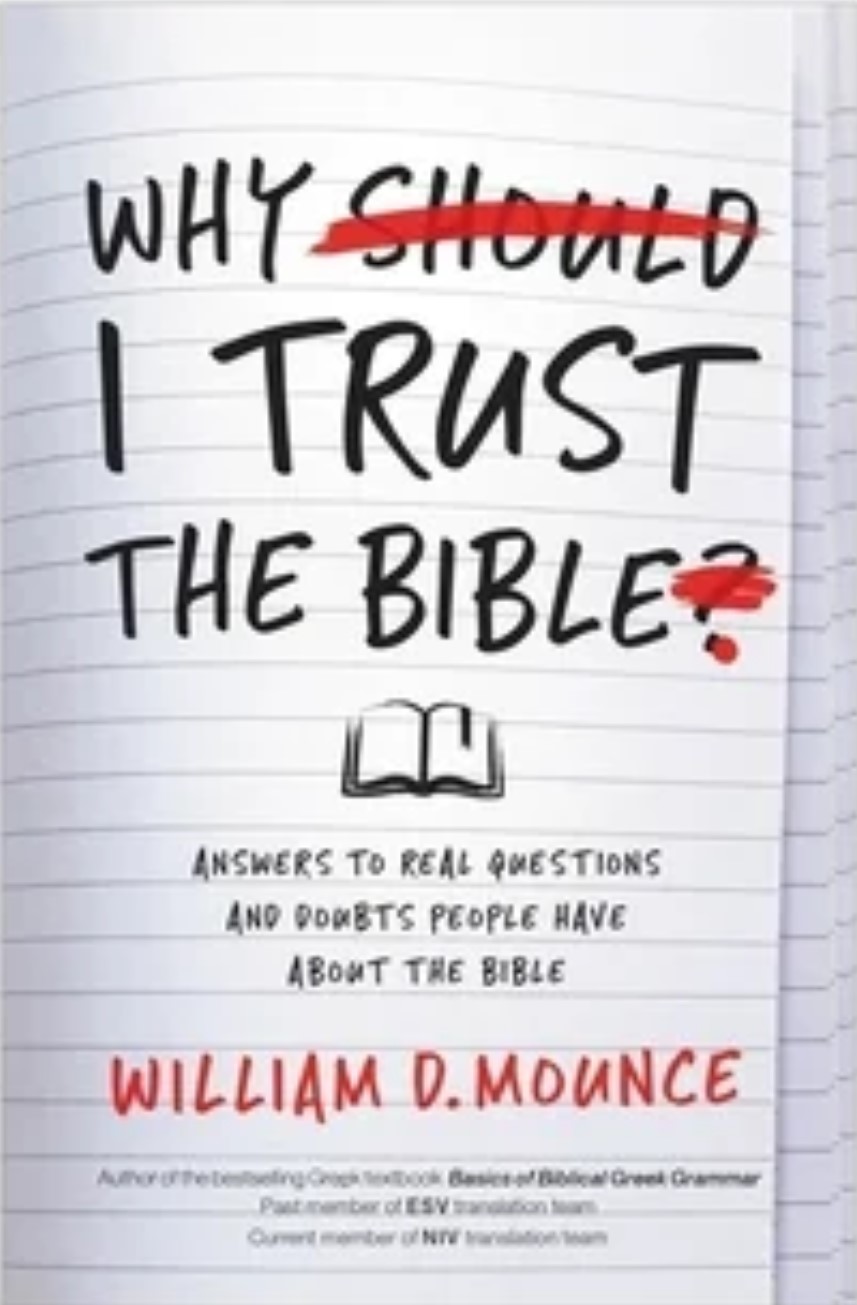
Downloads
Recommended Readings
Links
About BiblicalTraining.org
BiblicalTraining.org wants every Christian to experience a deep and loving relationship with Jesus by understanding the life-changing truths of Scripture. To that end, we provide a high-quality Bible education at three academic levels taught by a wide range of distinguished professors, pastors, authors, and ministry leaders that moves from content to spiritual growth, all at no charge. We are a 501(c)(3) non-profit funded by gifts from our users. We currently have over 180 classes and seminars, 2,300 hours of instruction, registered users from every country in the world, and in the last two years 1.4 million people watched 257 terabytes of videos (11 million lectures).
Our goal is to provide a comprehensive biblical education governed by our Statement of Faith that leads people toward spiritual growth.