Why I Trust My Bible - Lesson 9
Textual Criticism: Are the Greek Texts Hopelessly Corrupt?
It does no good to talk about inspiration and canonization if the church altered the contents of the Bible through the centuries. And why are there differences among the Greek manuscripts? This is the topic of textual criticism. The current situation is that we are confident of 99% of the New Testament text, and the 1% we are unsure of contains no significant theological doctrine.

1. Challenge
a. Misquoting Jesus: The Story Behind Who Changed the Bible and Why
b. Mark 16:9-20 and John 7:53–8:11
2. Historical process
a. Autographs
b. Manuscripts (mss)
c. Variant (reading)
3. Types of variants
a. Omissions/additions
b. Differences
c. Footnotes “other ms(s) read”
4. “Textual Criticism”: which “reading” is most likely original?
a. External criteria
b. Internal criteria
5. What did they find?
a. Only two passages of any length
1) John 8
2) Mark 16:9-20
b. A couple dozen variants involve one or two verses
1) Matt 6:13
2) Luke 22:43-44
3) 1 John 5:7-8
4) John 5:4
c. Remaining passages are a word or two at best
1) Many of the smaller variants are easily decided on (Matthew 5:22)
2) Insignificant types of differences account for the vast majority of “errors”
3) Left with very few that are important
a) Mark 9:29
b) Mark 1:41
6. How many variants are there?
a. How do you count variants?
1) Ehrman says there are 400,000, more errors than there are words
2) Example of 10,000 mss and 1 ms
3) Example of five manuscripts
b. How many variants are there?
1) Variants in two texts/groups
2) Two oldest and best mss
3) 5,000 – 10,000 versions
c. What is the significance of these numbers?
7. Statistics don’t lie, but interpretation can be suspect
a. Not every word is suspect.
1) How many places are there questions?
2) How many of these places are significant?
b. The bulk of the variants are insignificant
c. Obvious changes where we can see what was original
d. Some “families” are better than others
e. Textual Critics have done a great job
f. The multiplicity of mss encourage us that we are getting closer to the originals
g. Dan Wallace (CSNTM) concludes
1) We have the original Greek of the NT in the many manuscripts.
2) We just don’t know which text has it for a given verse
8. Conclusion: Do not doubt your Bibles
a. 5,800 manuscripts, with none of the autographs
b. 99% of the text is sure
c. That 1% contains no significant Biblical teaching
9. Have Scholars/Translators tried to hide these issues?
a. UBS5 lists 1,408 of the most significant textual variants
b. NA28 lists over 10,000
c. 282 in NIV (2011)
d. 460 in ESV
10. Ehrman on the “black hole”
a. Challenge
b. Truth
1) P52
2) 12 mss from the 2nd century
3) 64 from the 3rd century
4) 48 from the 4th century
5) Together you can reconstruct the entire NT several times over
1. Challenge
In this session, we’re going to look at a topic called Textual Criticism. Now don’t let the title scare you off! What textual criticism does, it looks at basically the Bible as it moves from the whole issue of the Canon up onto today. And how did the Greek text get here? And was it damaged at all in the process of coming into today? Bart Ehrman has written a very popular book called Misquoting Jesus. It’s a slightly misleading title because who wants to buy a book on text criticism, right? But the full title is Misquoting Jesus: The Story Behind Who Changed the Bible and Why. Well, the book is really on text criticism and the differences that we find as we compare the thousands of Greek manuscripts that we have. What Ehrman does in his book is he focuses on two sections, very large sections, the two largest sections of the New Testament that have some question about them. One is what we call the longer ending of Mark, which is Mark 16:9 to the end of chapter; and the other is the story in John 8 (at the end of chapter 7 and into chapter 8) on the woman caught in adultery. And he focuses on the issues raised by those two passages. And to be honest, he leaves the impression that there’s other passages that are that big and are that troublesome, and really means that we can’t trust our Bible today.
What Ehrman says on the Bible as a whole is that we have 400,000 errors in the Greek manuscripts of the Bible, which means that there are more errors than there are words. In our current Greek manuscripts, we have 138,216 words; so, 138,000. So, when he says that there are 400,000 errors, and only 138,000 words, it really does give the impression, I think, that every word of the Bible is suspect. And what that means is that, in his opinion, the Greek manuscripts of the New Testament are hopelessly corrupt, and that we have no idea really what the original said. If Ehrman were true (and other people saying the same thing), if Ehrman were true, it would really be significant, wouldn’t it? I mean, if in fact, as you go from the period of Canonization (the end of the 4th Century), up until the present, if the Greek manuscripts of the New Testament were so hopelessly corrupt that we don’t really know what was written originally, then issues of orality and the Gospel writers purposes in historicity and Canonization, all those things would be irrelevant, because whatever they worked with, the argument is that we don’t have them. So, if Ehrman and his buddies are right, it really is significant. But as you can imagine, I don’t think that Professor Ehrman is accurate on this.
2. Historical Process
Let me start by explaining the historical process and some of the key terms. Now the whole issue of Textual Criticism is really technical and really complex. Ehrman is well trained under Bruce Metzger in this issue. But thankfully we have people like Dan Wallace, a professor at Dallas Theological Seminary, who has written a standard 2nd year Greek textbook, and perhaps most importantly, he started a ministry called The Center for the Study of New Testament Manuscripts.org (csntm.org). And what Dan is doing is he has permission to be photographing Greek manuscripts, old Greek manuscripts, that have never been catalogued before. They’re buried in the archives of the churches in Turkey and that area. So, what Dan is doing is incredibly important. He is a phenomenal textual critic, every bit as good as Bart Ehrman. I like to say that either you’re a text critic or you have a life, because the science is so technical, it’s like you can’t do anything else. But fortunately, Dan Wallace is able to do considerably more. But anyway, that’s the issue. So…
The first term is ‘autographs.’ Autograph is the term we use to describe the original documents. So, when Paul sat down and had his amanuensis write out of Romans, that piece of parchment (probably what he wrote on) is called the autograph. Well, these autographs were all written on parchments; on biodegradable forms of material. We don’t have any autographs, okay, so get that taken care of up front. We have none of the originals, and I don’t know of anyone who claims that we do. We just don’t have any of those. But what we have are thousands and thousands of manuscripts. A manuscript is simply a copy. So, when Paul wrote the letter to the Romans, sent it to the Romans, sent the autograph to the Roman church, other people, other churches would have found out about this great letter, and they would have wanted copies made so they could have a copy, and they could read it, and they could keep it. Okay, those copies are called manuscripts, and if you look in the footnote of your Bibles, sometimes it will be ‘other MS,’ (which is singular for manuscript), or ‘other manuscripts (MSS) have a different Greek reading.’
Anyway, that’s what a manuscript is. A manuscript is simply a copy. And when you compare the manuscripts, what you will find is that in places they’re different, and every place that they’re different is called a variant. And so, if you have three differences for one word, those are three different variant readings. Okay? So, you have autographs, you have manuscripts, you have variant, you have variant readings. But that was the historical process that they went through to make copies and distribute them. And as we compare all these manuscripts, we see that there’s different kinds of variants. One of the kinds of variants is either omission or addition. In other words, there will be one manuscript will have a word or a phrase, and another manuscript won’t have that word or the phrase. Now, the Mark 16 and John 8 are the two longest (there’s nothing close to those elsewhere in the New Testament). They’re the two biggest variant passages.
But another good example is the last sentence of the Lord’s prayer, “…for thine is the Kingdom, and the power, and the glory forever. Amen.” Clearly, we know that that was added centuries later. Jesus never said it as the end to the Lord’s prayer. We know that also the church tended to make things a little loftier, a little more highfalutin, and this certainly fits in that category. But for many reasons we know that Jesus never said that verse.
3. Types of Variants
Or you have a passage like in John 5:4. Jesus goes to the pool. There’s someone been lying there for 38 years. Jesus asked the question, “What are you doing here?” And you read through the story, and any of the modern translations, and you go, “Wait a minute, where’s verse 4?” Well, verse 4 says that “…an angel of the Lord would come down and stir up the water and the first person in would be healed.” Now we know beyond the shadow of a doubt that John never wrote that; it was added later. And you can see why a scribe would be writing along and he’d go, “Why was this guy lying there for 38 years? Well, there was a tradition that an angel of the Lord…and I better explain it.” You can see how easy it would be for a scribe to add that.
Another really interesting illustration (you may need your Bibles to see this) is in Matthew 17:21. You go to 17:20, and it’s the story of the Transfiguration, exorcism after the Transfiguration. And Jesus is explaining, you know they have little faith; that if they had faith the size of a mustard seed, they could tell the mountain to get up and leave. That’s in verse 20; verse 22… Wait a minute, what happened to verse 21? There’s no verse 21. Well, there’s a footnote, and the footnote says, “Some manuscripts include here words similar to Mark 9:29.” So, if you flip over to Mark 9:29, you’ll see that there is a verse—and this one does belong in the Bible. It happened when the disciples said “Why can’t we cast out this demon?” And in Mark 9:29 Jesus replies, “This kind can come up only by prayer.” And if you have some other Bibles, you’ll see that it also is, some have ‘by prayer and fasting.’ Well, one of the things we know that the scribes used to do was to try to get the Gospels to agree with each other. So, you read that initially in the Matthew 17 passage, and you can see a scribe going, “Oh! There’s another verse over in Mark; it fills out the discussion. I better add it in.” But anyway, apart from the specifics, those are illustrations of the possibility that there were additions or passages removed.
There’s another set of variants, and that is where they’re just different. In other words, it’s not a matter of a word or a phrase being present one and absent in the other. It’s that they’re just differences. For example, the name for John, Yiannis, can be spelled with two ‘nu’s’, (the Greek ‘n’), two ‘nu,’s’ or one. It has zero difference in meaning. They’re variant ways to spell his name. But every time you get a difference in spelling, that counts as a variant. Or the Greek word for ‘he is,’ it’s ‘sd’, or you can put an ‘n’ (a ‘nu’) on the end and get ‘sdn.’ Zero difference in meaning. But those kinds of differences are all through the Greek manuscripts. Is it ‘sd’ or ‘sdn’? Well, those are variants. Well, they may be variants but they have zero meaning. They’re of zero significance. They both mean ‘he is,’ or ‘it is,’ or ‘she is.’
Another kind of difference is the article with proper names. Greek tends to have an article in front of proper names. So, you just don’t say ‘Jesus,’ you say, ‘the Jesus’ (O Lesous), and of course when we translate it, we don’t say ‘the Jesus,’ we just say ‘Jesus.’ But you will find that you look at names in these different Greek manuscripts, some will have the article (O Lesous), and some don’t have the article (Lesous). Any difference in meaning? Zero difference in meaning. Zero difference in meaning. There are unintentional errors. Interesting category, but a great example is Romans 5:1. And in Romans 5:1 Paul has just gone through the whole thing that justification is not through works; it is through faith in Jesus Christ, the kind of faith that Abraham has. And you get to the end of Romans 4. It’s a very significant break in the letter.
And in 5:1 Paul says, “Therefore (according to one Greek set of manuscripts), let us have peace with God.” The other is, “We have peace with God.” Now, what would be the difference? Well, if it’s ‘let us have peace with God,’ that’s a real significant difference, isn’t it? Because you’re not saying we are at peace, but we need to pursue it. The other manuscripts say ‘We have peace with God.’ It is concrete; it is real. Because of our justification by faith and not by works, we have peace with God. You know what the difference is between those two? ‘Echamin,’ ‘echomin.’ One of the ways in which copies were made is that a person would read it and the scribes would write it. It wasn’t all just, you know, one-on-one. But sometimes they had these schools of scribes where they were done a faster way; again, I would read it and ten scribes would write it.
You can hear how you could have confusion between ‘echamin’ which is ‘we have,’ and ‘echomin’ which is ‘let us have.’ You go, “Wait a minute, I don’t hear any difference.” Well, it’s the ‘o’ sound, long or short. I’ll exaggerate it: ‘ech-a-min’ or ‘ech-o-min.’ In reality they’re pronounced very, very similarly. Well, you can see why people, one would hear ‘echamin,’ the other would hear ‘echoman,’ and you would get differences. So, there are unintentional differences that are like that.
But again, there are also intentional differences of making one Gospel agree with the other like we’ve already seen. In Matthew it is, ‘blessed are the poor in spirit;’ in Luke 6 it’s, ‘blessed are the poor.’ Well, you can imagine there are some Greek manuscripts of Luke that try to fix it to be the same, and say ‘blessed are the poor in spirit.’ Because it is kind of weird to pronounce God’s blessing on someone just because they don’t have money, right? Well, anyway, you find those kinds of intentional differences.
So, types of variants we have are omissions or additions of words or verses, or we have variances where they’re simply different for lots of different reasons. And that’s why if you look in the bottom of your Bible there’ll be footnotes that’ll say ‘MSS’ (other manuscripts have). And what they’re doing is that the translators are showing you that they’re following one set of Greek manuscripts and translating what they have in the body of the Bible, but they recognize that there are other manuscripts that have an important difference, and that difference is put in the footnote. I mean, translators have to decide which one is going to go in the body.
But again, if it’s a very important variant, if there’s strong evidence that perhaps the other reading might be accurate, we always tell you in the footnote. So, you’ve got to understand, by the way, apart from the Net Bible, translators hate footnotes. This is one of the things I learned when I started doing this. Getting a footnote passed on the ESV was virtually impossible. We as a group did not want to do it. We wanted to make our decision as to what was the best possible. I wasn’t on the NIV committee when these footnotes were initially done, but it’s still pretty hard to get a footnote in the Bible. So, when you see a footnote, there’s something that’s really significant about it, okay? Alright. So anyway, those were for just pure English readers; these variants, some of the variants are listed below.
4. Textual Criticism - Which Readings are Most Like the Original
Anyway, so that’s the problem. You have thousands of Greek manuscripts, 5,900 of them, and you have differences as you compare them. And so textual criticism was developed as a science to figure out which reading, okay, which of these two different variants, is most likely original. And this is where it gets hyper-technical, and I don’t want to go into too much. There’s external and internal criteria. For example, external criterion is how old is the Greek manuscript? A Greek manuscript from the 4th century is going to be more important than a Greek manuscript from the 11th century, right? There’s been 700 years between them. Well, you’re going to prefer the much older Greek manuscript kind of by default. Things like the quality of writing, the evidence is that the scribes (especially in the first several hundred years), were very careful in how they wrote. They’re neat. I often compare it to if you miss a class and you have two buddies in a class, you say, “Can I borrow your notes to see what I missed?” And if one set of notes is really clean, and organized, and indented, and the other one is messy, and sloppy, with misspellings, which one are you going to go with? You’re going to borrow the neat ones, right? Well, we kind of do that in text criticism as well.
But there’s also internal criterion. And mainly what we do (I should say what the text critics do), is they look at the two different readings, and they say “Which one is the most likely to be original? Which one would most likely have given rise to the other readings?” So, for example, the disciples can’t exorcise the one demon, and Jesus explains to them in Mark 9, “This kind does not come out except by prayer.” And some manuscripts add ‘and fasting.’ Okay, is it more likely that Jesus said, “This kind does not come out except by prayer,” and later on someone added in ‘and fasting’? Or is it more likely that Jesus said, “This kind (this kind of demon), doesn’t come out except by prayer and fasting.” And later on someone dropped ‘and fasting’? Which reading gives rise to the other? Well, it’s virtually inconceivable that if Jesus had said, “…prayer and fasting,” that the ‘and fasting’ would have been dropped. I can’t think of a single reason why they would have dropped ‘and fasting.’ We generally believe that information was added. We rarely see examples of where information was dropped out of the Bible. And that’s interesting, by the way. In a lot of the, should I say, fundamentalist attacks on anything but the King James; they charge that these modern translations have left verses out. Well, 99% of the people out there would flip it and say, “No, these verses were added later. And so, we’re not going to put in verses that aren’t original.”
5. What Do They Find
But anyway, textual criticism has a set of guidelines. They look at external issues. They look at internal issues. And that’s how they make their mind up when they’re comparing manuscripts on a certain passage. Well, what do they find? What do the text critics find as they’ve done the work? Well first of all, there’s only two passages of any length in the Bible (in the New Testament) that are significant. Okay, the Mark 16 passage and the John 8 passage. And there is zero possibility that those two passages are original. Zero. I mean there’s just no way those two passages were written. And I’m not some raving liberal, leaving paragraphs out of the Bible. I respect the work of text criticism, and John never wrote it, and Mark never wrote it, and someone added it later on; and hence it’s not part of the Bible.
Let me give you some examples. In John 8, the first major manuscripts that we find the story of the woman caught in adultery is in a manuscript called Bezae, 5th or 6th century. No copies of John before that have the woman caught in adultery. We can see as we look at the manuscript tradition that the story of the woman caught in adultery is fit into different places; sometimes we find it after verse 36, after verse 44, at the end of the Gospel, and even at Luke 21:38. Well that’s one of the real signs that the passage isn’t original because people are looking for different places to place it. And the reason they would do that is that the story of the woman caught in adultery is in the worst possible place, because chapter 7 and most of chapter 8 are on the same topic. It really interrupts the flow of the argument, and it gets stuck right there. It’s a terrible place to put it because it’s not related to (chapter) 7; it’s not really related to (chapter) 8; but (chapter) 7 and 8 are related to each other, okay?
We find sometimes the story added with scholia. Scholia are little notations in the margins where the scribe is saying “Ah, there’s a problem with this passage.” And all they do is they mark it to indicate that there’s some question about it. So, there’s no way that John 8 was written by John. Now, most scholars argue (and I’m not really convinced this is true), but most scholars argue that it did happen; John never actually wrote it though. So, most people believe that the incident of the woman caught in adultery actually did happen and Jesus responded in a way that no rabbi in the 1st century would respond, that’s why they think it’s original. But we know from the text that John never wrote it. Alright?
Mark 16 verses 9 and 18, and we call it the ‘longer ending’ because there’s also a shorter ending. Looks like it was added much earlier, about the middle of the 2nd century, and apparently people were uncomfortable with how Mark 16:8 ends. The women left the tomb in fear, and that kind of left hanging. And personally, I think it’s a great ending, fear is reverential awe. How else do you respond to seeing the risen Lord, the announce of the risen Lord, I mean—and other than in reverence and awe; well, fear (biblically). But anyway, a lot of people don’t like the ending. Well, but if you look at the manuscripts (Sinaiticus and Vaticanus are our two oldest, and best, and most complete manuscripts), they don’t have the ending on Mark; they don’t have it. In some of the ancient translations that were done very quickly, they don’t have it. Some of the manuscripts include the longer ending of Mark, but they have the scholia by them showing that there’s some question about them.
It’s interesting, the early church fathers never discuss it. They discuss everything else in the Bible, but they don’t discuss this passage. There’s two other endings to Mark. Why would there be two other endings if the longer ending existed. Well, you have other people being uncomfortable with the women who left the tomb in fear, and they’re coming up with different endings. But that implies that the longer ending didn’t exist. Eusebius, historian of the 4th century, says that “Accurate copies of Mark end at verse 8, and the remaining verses are omitted (he said) for almost all manuscripts.” So Eusebius, in the 4th century, was very aware that the best Greek manuscripts of Mark ended with the women being fearful. So anyway, I went into some detail on that because this is a pretty big deal. But I also wanted to kind of give you a feel for how text critics do their work. Those are the only two large passages that are in question at all in the New Testament, okay? There aren’t any other paragraphs that are questionable at any level. Alright.
Well, second of all, there are a couple dozen variants that are one or two verses, but not many. In Mark 6:13, the ending of the Lord’s prayer, apparently created from 1st Chronicles 29, verses 11-13. That’s “For thine is the Kingdom, the power and glory forever and ever.” In Luke 22 verses 43 and 44 (you can check it), there’s a variant there. One of the more interesting ones is 1st John 5:7-8. This is the NIV (let me just read the context a bit), it said, “This is the One” (speaking of Jesus) “This is the One who came by water and blood, Jesus Christ. He did not come by water only, but by water and blood. And it is the Spirit who testifies because the Spirit is the truth. For there are three that testify: the Spirit, the water and the blood; and the three are in agreement.”
Okay, that’s what the vast majority of Greek manuscripts have. But there is another tradition that got into the King James. And the Greek doesn’t show up until the 16th century. And you’ll see it in the footnotes, it says ‘Llate manuscripts of the Vulgate’ (the Vulgate’s in Latin). “They have testified in Heaven, the Father, the Word and the Holy Spirit, and these three are one. And there are three that testify on earth.” Well, if those words were actually written by John in 1st John 5, it’d be a really important testimony to the Trinity, right? But there’s zero question, John never wrote those verses. Now this is Metzger’s little commentary that he has on these things. And here’s what he says about the Trinitarian passage, “The passage is absent from every known Greek manuscript except for eight.” Wow! All gone except for eight. “And these eight contain the passage in what appears to be a translation from a late recension, a late version, of the Latin Vulgate.” In other words, they appear to have been translated from Latin back into Greek. “The passage is quoted by none of the Greek fathers. It’s absent from the manuscripts of all ancient versions, all ancient translations.” You look at that and you go, “There’s no way that John wrote that.” Now you can see why those verses would have been added, right, because they make a statement about the Trinity. And, of course, when the Trinity was being debated, if they were original, they would have been quoted a lot.
They aren’t quoted. They don’t show up until the 16th century. They got into the King James Version. And it’s really interesting, I’ve heard people say very vile, ungodly things about translations that leave out that, because “They deny the Trinity.” Nah, we don’t deny the Trinity, that’s foolishness. Well, it’s more than foolishness but, it’s foolish. We don’t deny the Trinity. We just don’t think that—we know that the best Greek manuscripts don’t have that statement of the Trinity. And if we want to argue for the Trinity, we’re going to go to passages that we know are authentic, and really do teach about the Trinity. Alright. So anyway, but that’s another passage of where the variant is one of two verses. John 5:4 is another good example of a sentence length variant; the angel coming down stirring up the waters.
6. How Many Variants Are There?
Craig Bromberg, in his book Historical Reliability, gives a whole list of these verse-long variants, pages 630-633. If you want to look them up, you can. So, there are the two big paragraphs, there are a few sentence length variants, and the rest of the variants are just a word or two. And again, this is really important, because remember the backdrop is Erhman saying there’s 400,000 errors, more errors than there are words. And what I’m trying to help you see, in a very technical discipline (text criticism), that that 400,000 gives really a fundamentally wrong impression of the state of the Greek manuscripts. But the remaining passages are simply a word or two, and most of them are very easily decided on. For example, Matthew 5:22 says, “Anyone who is angry with a brother or a sister…” And some manuscripts added ‘without cause.’ Well, there’s no way that if Jesus said ‘without cause’ it’d be dropped. But you can see how someone saying, “And he was angry with a brother or sister… Oh, that’s harsh, we need to soften it. Oh yeah, this is anger and there’s no reason to be angry.” All right.
And we talked about some of the other kinds of one or two-word variations: sd vs sdn, Yiannis (John), with one or two n’s. Sometimes they flipped the order ‘Jesus Christ’ to ‘Christ Jesus.’ Sometimes synonyms are used. Sometimes there is an article or not an article; there’s a conjunction or not a conjunction. And again, you look at these, and they’re pretty easily decided on. But they’re just not important. The vast majority, I should say, are not important.
Now, there’s a couple that are kind of important, and this is an illustration that Dan Wallace gives in his book. And it’s the one in Mark 9:29, “This kind does not come out except by prayer and fasting.” What’s important is we know that ‘and fasting’ was added later, but what’s important about it is that this is the only passage that connects fasting with exorcism. And that makes the variant especially interesting. When it comes to exorcism, obviously it requires prayer, but does it also require fasting or not? And I would just say because the ‘and fasting’ is questionable, don’t derive your theology of fasting from this passage. Go find the passages that actually talk about fasting, and develop your doctrine of fasting from there. Even for exorcisms, I wouldn’t develop much theology of exorcisms from an uncertain verse.
Another minor one that actually is, I think important, and that is in Mark 1:41. It says, “A man with leprosy came to Jesus and begged him, on his knees, ‘If you are willing, you can make me clean.’” And most translations will say something like “…Jesus was filled with compassion.” Well, that’s the way you would expect of Jesus, right? But when you apply the rules of text criticism, I think the better reading is “Jesus was indignant.” He was mad. Actually, I believe this is the only passage in the Bible that says Jesus got angry. Cleansing of the temple, never says he was angry. Jesus didn’t appear to get angry. But he got angry here. He was indignant; he was mad. The reason you can see why scribes would have changed it to ‘filled with compassion.’ And ‘filled with compassion,’ the Greek word for that is very similar to the Greek word for being indignant; very, very similar. It’s a very minor little change.
But you can see why a scribe would ask, “Why was Jesus mad at the disciples?” They were just trying to figure this out. “You’re only halfway or so through his ministry; why would he be mad at them?” So, they changed it to ‘filled with compassion.’ Or why would he be mad at the boy who had the demon? Well, this is an exegetical issue; I don’t think he was mad at that. I think he was mad at sin. I think the only thing that made Jesus mad was, he created the world and he created it good, right? (Genesis 1 and 2.) He created it good. Sin came in and messed up his world. Remember, this is all his. Okay, he created. He put all the laws of nature in place, he feeds the birds; this is his world, and sin’s messed up something he worked hard—could you say that? Worked hard to create. And Jesus was angry. He was angry at sin. He wasn’t angry at the disciples. He berates them for not having much faith, but that’s not anger. So, you can see it’s a minor little thing: ‘indignant,’ ‘filled with compassion.’ But it’s kind of important. I think it’s kind of important. Anyway, those are the kinds of variants that we have to deal with. Okay? And again, I know I’m taking a little longer to explain this, but it’s a very technical field, and Bart Ehrman’s book is doing a lot of damage, and I want to make sure that you have enough background in all of this to be able to answer some of the charges that are brought.
One of the really interesting questions then, now that you have a feel for variants, how many are there really? How many variants are there, really? Erhman says there’s 400,000, more than there are words in the Bible. Well, it all depends upon how you count. I mean frankly, it all depends upon how you count. Let’s say you have 10,000 manuscripts, and this particular word is identical in all 10,000. And then you discover some 12th century manuscript that has a different word. That’s counted as a variant; actually could be counted as two variants. So even though there’s 10,000 manuscripts that all agree, if this one disagrees (it doesn’t matter how early or late it is), that’s counted as two different variants. Here’s some silly example: in 1 Thessalonians 2:7, “Paul and Silas were…” And again there is a variant issue here, either they were ‘gentle among you’ or were ‘little children among you’, and those two words are very, very similar. But one medieval scribe wrote, “We were horses among you.” Again, the word for ‘horses’ is very similar to the word for ‘little children’ and ‘were gentle.’ So, you can see why they made a mistake. Now that counts, though, as three variants. The first two were interesting and a little hard to decide; the third one… Paul’s not saying he’s ‘horses,’ but that still counts as a variant. See the problem?
In John 1:30, John says “…after me comes a man…” (‘aner,’ hear the ‘n’ sound, ‘aner.’) One codex says, ‘after me comes heir,’ and heir is ‘aher,’ not ‘aner,’ ‘aher.’ They dropped off the ‘nu,’ that’s all they did. But again, it counts as two variants. So, understand that variants are whatever you have differences in the manuscript.
Let me do it a different way: let’s say you have five manuscripts, okay? One has Yiannis (John’s name with two n’s). One has Yianis with one ‘nu,’ one ‘n.’ One has Petros, Peter. And the other leaves the name out altogether. That counts as four variants; but see, it’s one passage. Four variants. And even though three of them are almost identical, two ‘nu’s or one ‘nu,’ versus Petros versus nothing, it still counts as four variants. And so, numbers can be misleading.
Let me give you a couple of other ways to look at how you count variants, because again, why would you trust a Bible with 400,000 errors? Well, you realize the number 400,000 is really misleading. It might be technically accurate, but it is—it can be misleading. For example, let’s take just two manuscripts. Let’s take our two very best Greek copies of the New Testament. If you compare them, there’s about 2,000 differences. In other words, there are six to ten places in each chapter where there’s a difference. That still sounds like a lot, doesn’t it? Not 400,000. If you compare the Greek text behind the Kings James, and you compare the Greek text that all modern translations use now, there’s 6,577 places where they’re different. Wow, 6,577 differences, places, variants! That’s a lot of places where they’re different. Well, they are. But it’s not 400,000, right?
Another way to look at these numbers of variants is how many variants are significant enough to even be mentioned in our Greek Bibles. When I have a Greek Bible, along the bottom are the list of all the major variants that matter to me as a translator, as a scholar at all. But if you look at the different Greek texts that we use today, how many are listed? Well, The United Bible Society, the 5th edition, has 1,408 footnotes. In other words, in the entire Greek New Testament, there’s 1,408 places that they thought where it was important to point out a difference among the Greek manuscripts. Far cry from 400,000, right? If you have the Nestle-Aland 28th version of the Greek, there’s about 10,000 places that they list. Again, that’s a lot, 10,000 is a lot. It’s not 400,000. And it’s certainly not every word that becomes suspect. The way you get to 400,000 is that you have to start with the 5,900 Greek manuscripts that we have.
This is the total number of manuscripts that we have: we have 5,900 Greek manuscripts. But we have 10,000 Latin; we have 5,000-10,000 versions of the Bible in other languages; and we have over a million quotations among the early church fathers. I am not quite sure how Professor Erhman weighs all of those, but you have to use all of those to get up to 400,000, alright? The real question, though, is how many places are there variants, and how many of those variants are important. Well, I would say the UBS’s 1,408 is a much more accurate number on what is actually significant. Professor Erhman’s conclusion is that the Greek manuscripts are completely hopelessly corrupt, but we have a different—because I think that while statistics don’t lie, interpretations of statistics can be suspect. While there are more variants than there are words at one level, it doesn’t mean that every word is suspect.
That’s what’s critical that you understand, not every word of the Bible is suspect. The real question’s how many places are there questions, and how many of those places have significant questions. And the number for that is infinitely lower. The bulk of those variants, by the way, are insignificant. Dan Wallace says 99% are insignificant. There’s no real effect on meaning. And again, as you look at those variants, you can see so many times where the changes were obvious, and it’s really easy to get back to what the original was. They’re harmonizing the Gospel accounts. New Testament citations of the Old Testament, sometimes the New Testament is brought in line with the Septuagint translation. Spelling errors, copying errors…understand the original Greek manuscripts are uncials. They were all capitals, no space, no punctuation; easy to skip a letter, easy to skip a letter. Hopefully you’ve got a good feel for the kinds of changes, and why they’re simply not important.
7. Statistics Don’t Lie, But Interpretation Can Be Suspect
Another thing that’s important, though, and that is—and again, this is really technical. I don’t want to get too far into it. But there are different what we call ‘families of manuscripts.’ And a family is basically geographical. And so, for example, we talk about a Western text type which is centered in Italy and that area. And since the center of the church moved to Rome, you would expect a lot of manuscripts to be copied there. And as you look at the manuscripts that come out of that geographical area, so many of them are sloppy. So many of them are—sloppy’s not the right word. We see a real willingness to change the original text, alright? The Greek manuscripts that come out of Alexandria, on the other hand, are much more obviously careful and not as open to changes. And so, obviously we are going to trust the Alexandrian text more than the Western text.
Some families are better than others, but one of the interesting ways to look at these things is to say, “Are we ever going to find (as we look at all these different manuscripts), are we ever going to find a variant that we don’t know about that could be original?” And I’m going to talk about this again in my conclusion, but the answer is, no. I mean, it’s unbelievably highly unlikely that we will find a variant that’s not present in any of the 5,900 manuscripts that we have. And 5,900, I should say, some of those are part of the Bible, but some of those are the whole New Testament. We’re simply not going to find a variant we did not know before.
Basically, text critics have done a really, really good job. I don’t know of any other area in biblical studies where there is near unanimous agreement that, as to the work of, you know, theologians disagreeing with each other. Exegetes to Romans disagree with each other. Greek grammarians arguing with the middle voice disagree with each other. But there’s very little disagreement, virtually none, on the overall approach of text criticism, and being confident that text critics have done their job. Yeah, there’s lots of places where we’re not sure whether it’s ‘O Lesous’ or just ‘Lesous.’ But again, that’s not a big deal. It doesn’t affect meaning. Text critics have really done a good job. And in fact, as we get more and more manuscripts—again in Dan Wallace’s ministry, they keep finding these more manuscripts, additional manuscripts. As we get more manuscripts, yeah, the number of variants are going to go up, potentially go up, but with every manuscript that you find, it’s giving us more confidence in the bulk of the Greek texts that we have. So again, I’m very thankful for Dan’s work, and may he continue to find hundreds of more Greek manuscripts, because it gives us more and more and more confidence in what we have.
In fact, Dan says that he is absolutely confident that we have the autographs. Alright, we have whatever the original was, we have it. Now when you go to this passage, or this passage, we’re not sure in places where this Greek manuscript represents the original, or this Greek manuscript represents the original. But one of them does, and we’re not going to be finding variants that we have never known before—never known about before, that could actually be original. The original is in there. We just have to make sure that we find them.
8. Conclusion
So, what’s the conclusion? And these are the important points, three things: number one, we have about 5,900 Greek manuscripts, either fragments, or books, or entire New Testaments. We have about 5,900 manuscripts with none of the autographs. We don’t have any of the originals. That’s ok. Number two, 99% of the text is sure. If you read commentaries, or you compare Bibles, you’re going to find that in 99% of the places they all agree as to what the Greek originally said. Point three, no significant point is ever questioned. Let me say in another way: that 1% that we’re not completely sure on contains no significant or major biblical doctrine. Yeah, the passage in 1st John 5 about the Trinity, that’s important, but we have the Trinity elsewhere in the New Testament. So, it’s not like the Trinity, the doctrine of the Trinity hinges on those two verses. But we know that John didn’t write that. But on those things where we’re not completely sure, ‘Lesous’ or ‘O Lesous,’ ‘Sd’ or ‘Sdin,’ where we’re just not sure, they contain no significant biblical doctrine.
In other words. nothing about the life of Jesus, nothing about the life of Paul and the growth of the early church, none of the doctrines that we believe as evangelical Christians, none of them are brought into question by the variants in the Greek manuscripts. And in fact, Professor Erhman actually says that in the appendix to his book. No Christian doctrine, no major Christian doctrine is brought into question. So, text critics have done their work, and they’ve done it well, and we all (whether we’re translators or scholars), have really benefited from these men and women that have devoted their lives, basically, to understanding these 5,900 manuscripts, and collating them, and working with them.
9. Have Scholars Tried to Hide These Issues
Those are the basic things I want to say on text criticism. But just because of some things that are going on recently, I want to append just a couple of other little things, and then we’ll be done on this issue. Some people charge that scholars and translators have tried to hide the fact that there is variants, and you’ve got to be so careful in critiquing people’s motives, because you don’t know. I mean, I’m not even aware of my own motives a lot of the time; neither are you. But man, you ought to be careful critiquing people’s motives. I remember, George Ladd was one of my seminary professors, and he hit this so hard the first day. He said, “Do not critique motives. One, you don't know what they are, and two, it doesn’t matter.” You argue on the facts, not on what you think the person might be thinking or saying, okay?
But on this whole issue of people like me have tried to hide these things, it’s so untrue, that either it’s stated in complete ignorance, or the person’s lying. There’s no other way to really say it. The UBS, the 5th Edition, like I said, it lists 1,408 places in the New Testament where there’s important significant differences among the Greek manuscripts. And what UBS does is they label them ‘ABCD.’ And again, the ‘ABCD’ are their opinion, but they’re really helpful. If they say this variant has an ‘A’ rating, it means they are absolutely beyond a shadow of a doubt sure what the Greek says. And there’s 502 of those. Okay, so that reduces the 1,408 number to below a thousand. They’re just absolutely sure that we have it right; there just may be something in the history of the Bible, the history of the church that made it important to show this other variant. But ‘A’ ratings mean “Don’t even think about it; we know it for sure.”
‘B’ ratings are “Yeah, we’re pretty sure, but there’s some strong evidence to the contrary, but we’re pretty sure.” That’s a ‘B’ rating. There’s 533 variants that have ‘B’ ratings. ‘C’ ratings mean “Huh, oh man, this one’s hard, this one’s hard; don’t be authoritative; it could be this or could be that.” There’s 366 ‘C’ ratings. And ‘D’ ratings mean “We don’t have a clue. We just don’t know.” And there’s 7 of them.
So, you start with that 1408, and if you even drop off the 502, we’re way below a thousand places where there’s no question. So that’s really encouraging. Nestle-Aland, Edition 28, lists about 10,000; far cry from 400. But the point is…they list them. They’ve always been there; they’ve been listed.
If you go to the NIV, the 2011 edition, there’s 282 footnotes that talk about manuscripts. In other words, “We’re telling you right here that there’s an issue.” In the ESV, there’s 460. In other words, you don’t have to worry about what’s lurking behind “That those bad translators are trying to hide from you.” Evangelical scholars, I think even non-evangelical scholars, have been very up front where these problem passages are. And they’re in the books; they’re in the Bibles. No one’s hiding anything. So, if you hear someone critique my motives, critique my buddies’ motives on the NIV or the ESV (I know most of the translators on the NLT; some of them on the Holman Christian), these are not people that hide anything. They really aren’t. They really aren’t.
10. Ehrman’s ‘Black Hole’
The other thing I wanted to mention is that Bart Ehrman talks about there being a ‘black hole,’ and this is a term that Professor Ehrman is using. And what he means is that there is a massive gap in time between the writing of the autographs and the earliest manuscripts that we have, like 400 years later. And what he’s saying is that we just don’t have manuscripts from this time period, and there’s no way to know if there was massive change, if they were altered, if they were theologically twisted, whatever be the case. He said, because you’ve got this 350 year gap or thereabouts, maybe 300 year gap, that even though we have manuscripts from the 4th century, we can’t trust them because there’s been this ‘black hole,’ this time period between the autograph and the earliest manuscripts, that we don’t have other manuscripts.
And a quote he has, and it’s been used quite a bit (it’s gotten pretty famous in the field) is, let me read it to you because it’s going to give you a feel for how good of a reiteration he is. He says “Not only do we not have the originals, we don’t have the first copies of the original. We don’t even have copies of the copies, or copies of the copies of the copies of the originals.” Michael Kruger in his book (it’s referenced on the lecture page), goes into quite a bit of discussion of this, and he argues that it’s not like a manuscript was around for ten years and then, you know, worn out and thrown away (while papyrus is biologically degradable). They actually lasted much longer, and we have evidences of very important manuscripts that, 400 years after they were written, they’re being re-inked. In other words, the writing was fading on them, but there was enough there that you could ink over them. So, if you want to get into this in more detail, check out Kruger’s book.
But let me give you the truth on this whole ‘black hole’ thing. Our earliest manuscript is labeled as P52; it’s papyrus (that’s why it’s ‘P’52). It has John 18:31-33 on one side and 18:37-38 on the other side, and it’s dated 90 to 100 AD, which has some very interesting ramifications for the writing of John. A hundred years ago, people were arguing that the Gospel of John was not written by the Apostle and was written middle of 2nd century. Well, we have a piece of it from the end of the 1st century, so it couldn’t have been written any later than that. We actually have 12 manuscripts from the 2nd century, and Dan Wallace has an interesting comment, “That by the end of the 2nd century,” he says, “Over 40, 40% of all the verses in the New Testament are already found in manuscripts within 150 years of the completion of the New Testament.”
So, in other words, these 12 manuscripts, by the end of the 2nd century, give us about 40% of the New Testament. That’s pretty significant, isn’t it? From the 3rd century we have 64 manuscripts, and from the 4th century we have 48 manuscripts, including many full copies of the entire New Testament. So, while some of these manuscripts are fragmentary, when you look at all of them, we can reconstruct the New Testament as a whole many times over. So, there wasn’t a ‘black hole.’ Would we like to have more 2nd century manuscripts? Yeah! More 3rd? Yeah! And, you know, maybe archaeologists will dig up more. Maybe Dan Wallace’s ministry will find some 3rd/2nd century manuscripts buried in some Istanbul church’s library, and he’ll photograph them for us. We’re not going to find less; we’re only going to find more. But the point is that we do have enough to trust that the really significant manuscripts from the 4th century, that there’s not this ‘black hole’ time gap between them and the autograph, that there are manuscripts in that time frame.
So again, that’s it on text criticism. We have about 5,900 Greek manuscripts, 10,000 Latin, 5-10,000 early translations, all the quotations from the early church fathers. We can reconstruct our Bible many times over from all of these resources. In fact, one writer says that we can reconstruct the entire New Testament simply from citations in the early church fathers. We don’t even have to have any of these other Greek manuscripts. The early church fathers, the early theologians, early leaders of the church quoted vast amounts of the Bible, and we can reconstruct it from them. But we have a lot of copies of the New Testament. Secondly, we’re absolutely convinced 99% of what we have is original, is the autographs. We simply don’t worry about it, and that 1% that we’re not completely sure of, contains no significant biblical doctrine, any significant biblical teaching on anything. The life of Jesus, the teachings of Jesus, the teachings of Paul, the rest of the New Testament just does not come into question, and Professor Erhman agrees. Thanks!
- Some people feel that it is wrong to ask fundamental questions such as whether or not they trust the Bible. But if you never seriously ask the question, you will never be convinced that it really is true and trustworthy.0% Complete
- Some question whether Jesus actually lived, claiming there's only one non-biblical reference. This is false; there are many more.0% Complete
- Learn about the reliability of the New Testament through oral tradition, the impact of Jewish oral culture, three approaches to orality, memorization techniques, corporate memory, scholarly presuppositions, the Holy Spirit's role, and the delayed documentation of the Gospels.0% Complete
- While the gospels are anonymous, tradition is very strong as to who wrote Matthew, Mark, Luke, and John, and all four authors were in a position to know the truth and we can trust their writings. If the church did not care about authorship traditions, they would not have picked these four.0% Complete
- If the biblical writers were not concerned about historical accuracy, we would expect more verses that would have answered the burning questions of the first century, and we certainly would not have the many embarrassing and difficult verses that we do have. The gospel is couched in historical fact, and if the events did not happen then the teaching is false.0% Complete
- Learn how to address perceived contradictions in the Bible by understanding harmonization, interpretation, and considering possible errors in secular sources, all while encouraging a trust in the Bible’s reliability.0% Complete
- Investigate whether Paul changed Jesus’ message. Despite different contexts and approaches, Jesus' and Paul's teachings align on core theological issues like justification by faith and ritual purity, affirming their compatibility.0% Complete
- Learn why trusting the Bible is rational despite the inability to prove it, and you'll gain tools to ask questions, strengthen your faith, encourage others, and counter opposing views with sound biblical doctrine.0% Complete
It does no good to talk about inspiration and canonization if the church altered the contents of the Bible through the centuries. And why are there differences among the Greek manuscripts? This is the topic of textual criticism. The current situation is that we are confident of 99% of the New Testament text, and the 1% we are unsure of contains no significant theological doctrine.
0% CompleteUnless you can read Greek, Hebrew, and Aramaic, you need a translation. But why are there so many, and why are they so often different? Can they be trusted? Bill Mounce, chair of the ESV translation for 10 years and currently on the Committee on Bible Translation that is responsible for the NIV, shares his answer to these questions.
0% Complete- Dr. Mounce shares personally why he trusts his Bible.0% Complete
Lessons
- Some people feel that it is wrong to ask fundamental questions such as whether or not they trust the Bible. But if you never seriously ask the question, you will never be convinced that it really is true and trustworthy.0% Complete
- Some question whether Jesus actually lived, claiming there's only one non-biblical reference. This is false; there are many more.0% Complete
- Learn about the reliability of the New Testament through oral tradition, the impact of Jewish oral culture, three approaches to orality, memorization techniques, corporate memory, scholarly presuppositions, the Holy Spirit's role, and the delayed documentation of the Gospels.0% Complete
- While the gospels are anonymous, tradition is very strong as to who wrote Matthew, Mark, Luke, and John, and all four authors were in a position to know the truth and we can trust their writings. If the church did not care about authorship traditions, they would not have picked these four.0% Complete
- If the biblical writers were not concerned about historical accuracy, we would expect more verses that would have answered the burning questions of the first century, and we certainly would not have the many embarrassing and difficult verses that we do have. The gospel is couched in historical fact, and if the events did not happen then the teaching is false.0% Complete
- Learn how to address perceived contradictions in the Bible by understanding harmonization, interpretation, and considering possible errors in secular sources, all while encouraging a trust in the Bible’s reliability.0% Complete
- Investigate whether Paul changed Jesus’ message. Despite different contexts and approaches, Jesus' and Paul's teachings align on core theological issues like justification by faith and ritual purity, affirming their compatibility.0% Complete
- Learn why trusting the Bible is rational despite the inability to prove it, and you'll gain tools to ask questions, strengthen your faith, encourage others, and counter opposing views with sound biblical doctrine.0% Complete
It does no good to talk about inspiration and canonization if the church altered the contents of the Bible through the centuries. And why are there differences among the Greek manuscripts? This is the topic of textual criticism. The current situation is that we are confident of 99% of the New Testament text, and the 1% we are unsure of contains no significant theological doctrine.
0% CompleteUnless you can read Greek, Hebrew, and Aramaic, you need a translation. But why are there so many, and why are they so often different? Can they be trusted? Bill Mounce, chair of the ESV translation for 10 years and currently on the Committee on Bible Translation that is responsible for the NIV, shares his answer to these questions.
0% Complete- Dr. Mounce shares personally why he trusts his Bible.0% Complete
Class Resources
Recommended Books
Why I Trust My Bible - Student Guide
We can no longer assume that people trust their Bible. The popular media has launched such an attack on the believability of Scripture that our people have serious questions...

Why I Trust The Bible
Answers to Real Questions and Doubts People Have about the Bible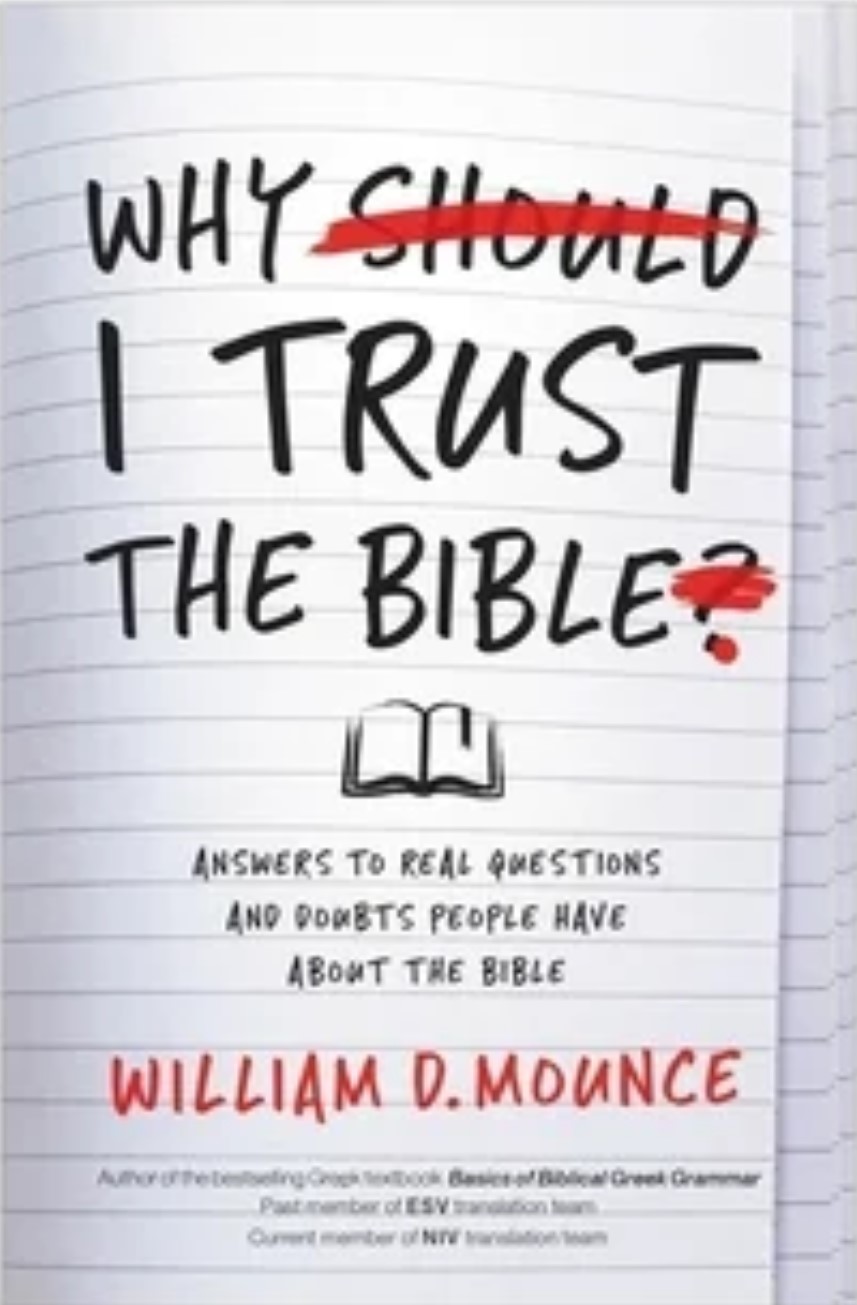
Downloads
Recommended Readings
Links
About BiblicalTraining.org
BiblicalTraining.org wants every Christian to experience a deep and loving relationship with Jesus by understanding the life-changing truths of Scripture. To that end, we provide a high-quality Bible education at three academic levels taught by a wide range of distinguished professors, pastors, authors, and ministry leaders that moves from content to spiritual growth, all at no charge. We are a 501(c)(3) non-profit funded by gifts from our users. We currently have over 180 classes and seminars, 2,300 hours of instruction, registered users from every country in the world, and in the last two years 1.4 million people watched 257 terabytes of videos (11 million lectures).
Our goal is to provide a comprehensive biblical education governed by our Statement of Faith that leads people toward spiritual growth.