Why I Trust My Bible - Lesson 4
Do We Know Who Wrote the Gospels?
Explore the authorship of the Synoptic Gospels—Matthew, Mark, and Luke. The lesson highlights that while the Gospels are anonymous, Church tradition strongly attributes them to Matthew, Mark, and Luke, who were well-positioned to accurately document Jesus' life and teachings. The dating of the Gospels is discussed, showing they were written within 60 years of the events they describe. The lesson also considers the argument that the Church would not have arbitrarily chosen the names Matthew, Mark, and Luke for the Gospels unless there was strong tradition supporting their authorship.

1. Challenge
Can’t trust since the gospel writers may have changed the message or didn’t know it to begin with
2. Traditional answers
a. First century documents
b. Within 60 years of the events narrated
3. Another way to look at this issue
a. Charge: Church picked a well-known, well-trusted person and attached his name to the gospel
b. We actually know this happened for other writings, based on the stories that were made up in later apocryphal gospels.
c. If the church had such a low regard for the issue of authorship, would they have attributed the gospels to these four?
4. Conclusion
1. Challenge - Eyewitnesses and Historical Jesus and Proof
In this session, we’re going to talk about the issue of the authorship of the Synoptic Gospels: Matthew, Mark and Luke. The challenge is that we don’t really know who wrote them, so people say. And because we don’t know who wrote them, we don’t know if they got the stories right because we don’t know who wrote them. We don’t know if the authors were willing to change the stories of Jesus. So authorship is a big issue. Bart Ehrman has written another book on this, and it’s entitled “Forged, Writing in the Name of God” and the subtitle is, “Why the Bible’s Authors Are Not Who We Think They Are.” It’s true that Matthew, Mark and Luke are anonymous; they don’t say on there who actually wrote them. And we think that the names were not formally attached to them until the Gospels were all put together in a codex, in a book format, and the different Gospels needed to be distinguished from each other. But so, it is true that Matthew, Mark and Luke, (those Gospels), don’t say who the authors are. So, Bart Ehrman and these other people are accurate as far as that is concerned.
2. Word of Mouth
But let me give you two answers. And the first one is a slightly more traditional answer. And the other one, Darryl and Craig make a very interesting point in their sessions. The traditional answer is that Church tradition is very strong that Matthew wrote the first Gospel, Mark wrote the second Gospel, and Luke wrote the third. The sayings of the early fathers as they recounted what they had heard; they’re actually very, very strong in terms of the authorship. Matthew was one of the twelve, and he was certainly in a position, as one of the twelve, to know what Jesus did and said. We’re told that Mark actually wrote the memoirs of Peter. In other words, behind the Gospel of Mark is Peter, and his retelling of the stories of Jesus’ actions and his teachings. Tradition’s very strong. And tradition’s pretty strong that Luke wrote the third, that he was a Gentile. He was not an eyewitness. He tells that in the very beginning in Luke 1. But he did his research, and he was a traveling companion of Paul’s. He had access to information about Jesus. And the traditions are strong that those three men wrote the first three Gospels. And the point is, not only that the tradition is strong, but all three of those are in a position to know what actually happened, to know what Jesus actually taught, and then to write it down in a trustworthy manner.
3.The Dates of the Gospels
Connected with that is the whole issue of dating, and let me show you this chart. And it’s divided between kind of the evangelical scholars’ dating of the Gospels, and more, the critical (I don’t like to keep calling them ‘liberal critics;’ I don’t want to put tags on things), but non-evangelical scholars and where they tend to date the writing of these Gospels. And I’ll come back when I’m done with this and talk about the significance.
But basically, you have Mark, and evangelical scholarship thinks he wrote late 50’s, early 60’s. More critical scholarship, late 60’s, early 70’s. Matthew, the date ranges from the 60’s to the 80’s. Luke is from the 60’s to 80’s as well. And John would have been written 80’s to 90’s, somewhere in that late date range. In other words, they were all written within about 60 years of the events. Now, you may say, “Boy, 60 years, that’s a long time.” But in an oral culture, it’s not that long. But it’s not that long when you compare it to other ancient biographies as well. Take Alexander the Great, for example. Alexander died in 323 BC, and his biographies were written in the late 1st century AD into the 2nd century AD. So, Alexander the Great’s biographies were written about 400 years after Alexander had lived. But we trust those biographies of him. We think that they convey basically accurate information. So, when you look at that 400 years, then all of a sudden fifty, sixty years in an oral culture is not really that long of a time period. And so, we have good strong traditions as to who wrote the first three Gospels. They were people who would have known Jesus, would have accurately known about Jesus or his teachings, and it was written within a relatively short time frame. So that’s one way to look at this whole issue of authorship. It’s so trustworthy.
But there’s another way to look at the whole issue of authorship, and both Darrell and Craig spend some time in their sessions, (as I said) talking about it. The challenge is this: because we don’t know who wrote the Synoptic Gospels, the Church was sitting there with these three anonymous Gospels, and they wanted people to trust them. They wanted people to believe them. So they just went out, and they said, “Hey, let’s pick Matthew, Mark and Luke. They’re respected people. People will respect their writings, will trust their writings, and let’s stick their names on the first three Gospels.” So that’s how the charge is often made. And in fact, in a sense there’s some truth to that because when we look at other books that were written after Christ, supposedly about him, that’s exactly what happened. Somebody would make up a story about Jesus (or Paul in this case). And so, it’s the “Acts of Paul and Thecla,” so supposedly this is things that Paul wrote. We have the “Acts of Peter.” Somebody made up a bunch of stories, and then they wanted people to believe it, so they went and got a very well-known, respected person, Peter, and they attached his name to it. So, we know that’s actually what did happen. The question is, is that what happened with Matthew, Mark and Luke? And the argument is this: if the Church was willing to just go get a name and attach it to an anonymous Gospel, would they have picked Matthew, Mark and Luke? And the argument is, no, you would not have picked these three people to give these anonymous Gospels credibility.
So let’s think about it. Let’s start with Mark because it was the first Gospel written. Who’s Mark? Oh, he’s that guy who ran home to Mommy, or whatever, in the middle of the first missionary journey. Oh, Mark, he’s the guy that split Paul and Barnabas. Why would you attach his name to the second Gospel? There’s no reason to. Well, the only reason is that there was a very strong tradition that Mark wrote that Gospel, and the Church honored that tradition. And it was important for them to get it right.
And there’s another way to look at it, and that is, since we know from Papias through Eusebius, that Mark was really writing down the memoirs of Peter, why is it not the ‘Gospel of Peter?’ I mean, that’s the person who stands behind it, right? Well, apparently the Church wasn’t willing to ignore the traditions about who wrote the Second Gospel. The tradition is strong that Mark wrote it, even though Peter stands behind it. But hey, the tradition is that Mark wrote it, and so they’re going to put the name ‘Mark’ on the Second Gospel. That tells you how the Church viewed authorship. They weren’t willing to ignore the traditions.
If you think of Matthew, well, he’s one of the twelve. Yeah, but he was a tax collector. And again, in our day and age, it’s probably a little hard to understand the total disgust, perhaps even hatred, that Jews had of tax collectors because these Jews were turncoats. They were traitors. They sided with the Romans. It’s not that they just took your money, it’s that they gave it to the Romans. Why on earth would you pick especially a Gospel like the first one that is obviously geared for a Jewish audience? Why would you pick the one disciple the Jews would dislike the most? It doesn’t make any sense, unless the Church understood that Matthew wrote that Gospel, and they respected that, and they attached his name to it.
What about the Third Gospel? Why would you pick Luke? Well, Luke was a, he was not an eyewitness. But he was part of Paul’s traveling group, and so, I mean, that bodes well for him. But still, he was a Greek. He wasn’t a Jew. He wasn’t there. He wasn’t an eyewitness of Jesus’ events. Why would you attach a Gentile’s name to a Gospel when you’re trying to get the right name to give the book credibility. Well, doesn’t make any sense, does it? So, the conclusion is that the Church was not willing to ‘willy-nilly’ attach people’s names to Gospels. What the Church was willing to do, was to respect and to accept the strong traditions as to the authorship of Matthew, Mark and Luke, even though Peter is behind Mark, and then to attach those names to him.
So, this whole thing on authorship (the argument, I think), falls apart. While they were anonymous Gospels, the Church tradition is very strong that it was Matthew, Mark and Luke. These people all had direct or very close indirect access to the stories of Jesus. And the Church wasn’t willing to attach just well-known names to Gospels to get them believed; that they wanted to honor the traditions. And so, we have the Gospel of Matthew, the Gospel of Mark, and the Gospel of Luke. I think that’s a fair conclusion to draw.
- Some people feel that it is wrong to ask fundamental questions such as whether or not they trust the Bible. But if you never seriously ask the question, you will never be convinced that it really is true and trustworthy.0% Complete
- Some question whether Jesus actually lived, claiming there's only one non-biblical reference. This is false; there are many more.0% Complete
- Learn about the reliability of the New Testament through oral tradition, the impact of Jewish oral culture, three approaches to orality, memorization techniques, corporate memory, scholarly presuppositions, the Holy Spirit's role, and the delayed documentation of the Gospels.0% Complete
- While the gospels are anonymous, tradition is very strong as to who wrote Matthew, Mark, Luke, and John, and all four authors were in a position to know the truth and we can trust their writings. If the church did not care about authorship traditions, they would not have picked these four.0% Complete
- If the biblical writers were not concerned about historical accuracy, we would expect more verses that would have answered the burning questions of the first century, and we certainly would not have the many embarrassing and difficult verses that we do have. The gospel is couched in historical fact, and if the events did not happen then the teaching is false.0% Complete
- Learn how to address perceived contradictions in the Bible by understanding harmonization, interpretation, and considering possible errors in secular sources, all while encouraging a trust in the Bible’s reliability.0% Complete
- Investigate whether Paul changed Jesus’ message. Despite different contexts and approaches, Jesus' and Paul's teachings align on core theological issues like justification by faith and ritual purity, affirming their compatibility.0% Complete
- Learn why trusting the Bible is rational despite the inability to prove it, and you'll gain tools to ask questions, strengthen your faith, encourage others, and counter opposing views with sound biblical doctrine.0% Complete
It does no good to talk about inspiration and canonization if the church altered the contents of the Bible through the centuries. And why are there differences among the Greek manuscripts? This is the topic of textual criticism. The current situation is that we are confident of 99% of the New Testament text, and the 1% we are unsure of contains no significant theological doctrine.
0% CompleteUnless you can read Greek, Hebrew, and Aramaic, you need a translation. But why are there so many, and why are they so often different? Can they be trusted? Bill Mounce, chair of the ESV translation for 10 years and currently on the Committee on Bible Translation that is responsible for the NIV, shares his answer to these questions.
0% Complete- Dr. Mounce shares personally why he trusts his Bible.0% Complete
Lessons
- Some people feel that it is wrong to ask fundamental questions such as whether or not they trust the Bible. But if you never seriously ask the question, you will never be convinced that it really is true and trustworthy.0% Complete
- Some question whether Jesus actually lived, claiming there's only one non-biblical reference. This is false; there are many more.0% Complete
- Learn about the reliability of the New Testament through oral tradition, the impact of Jewish oral culture, three approaches to orality, memorization techniques, corporate memory, scholarly presuppositions, the Holy Spirit's role, and the delayed documentation of the Gospels.0% Complete
- While the gospels are anonymous, tradition is very strong as to who wrote Matthew, Mark, Luke, and John, and all four authors were in a position to know the truth and we can trust their writings. If the church did not care about authorship traditions, they would not have picked these four.0% Complete
- If the biblical writers were not concerned about historical accuracy, we would expect more verses that would have answered the burning questions of the first century, and we certainly would not have the many embarrassing and difficult verses that we do have. The gospel is couched in historical fact, and if the events did not happen then the teaching is false.0% Complete
- Learn how to address perceived contradictions in the Bible by understanding harmonization, interpretation, and considering possible errors in secular sources, all while encouraging a trust in the Bible’s reliability.0% Complete
- Investigate whether Paul changed Jesus’ message. Despite different contexts and approaches, Jesus' and Paul's teachings align on core theological issues like justification by faith and ritual purity, affirming their compatibility.0% Complete
- Learn why trusting the Bible is rational despite the inability to prove it, and you'll gain tools to ask questions, strengthen your faith, encourage others, and counter opposing views with sound biblical doctrine.0% Complete
It does no good to talk about inspiration and canonization if the church altered the contents of the Bible through the centuries. And why are there differences among the Greek manuscripts? This is the topic of textual criticism. The current situation is that we are confident of 99% of the New Testament text, and the 1% we are unsure of contains no significant theological doctrine.
0% CompleteUnless you can read Greek, Hebrew, and Aramaic, you need a translation. But why are there so many, and why are they so often different? Can they be trusted? Bill Mounce, chair of the ESV translation for 10 years and currently on the Committee on Bible Translation that is responsible for the NIV, shares his answer to these questions.
0% Complete- Dr. Mounce shares personally why he trusts his Bible.0% Complete
Class Resources
Recommended Books
Why I Trust My Bible - Student Guide
We can no longer assume that people trust their Bible. The popular media has launched such an attack on the believability of Scripture that our people have serious questions...

Why I Trust The Bible
Answers to Real Questions and Doubts People Have about the Bible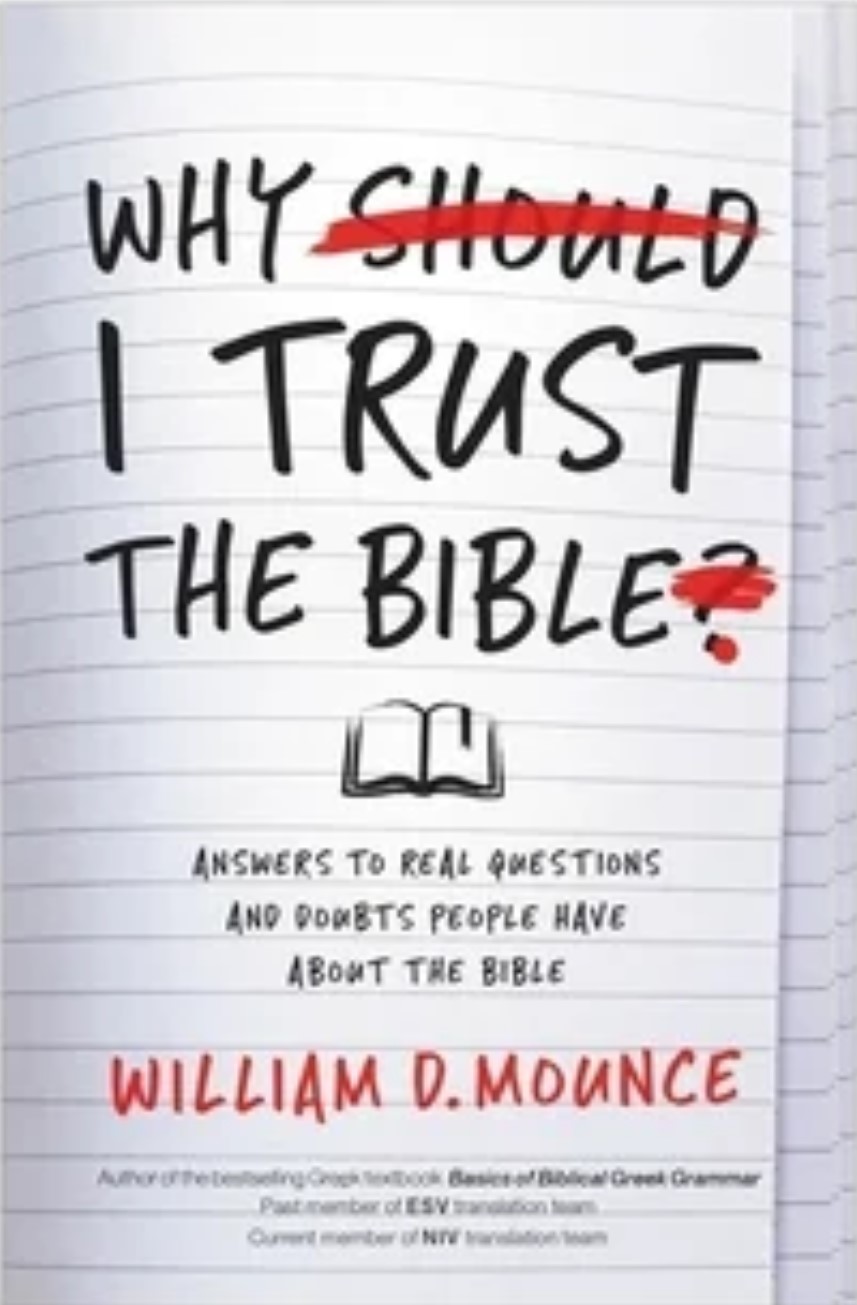
Downloads
Recommended Readings
Links
About BiblicalTraining.org
BiblicalTraining.org wants every Christian to experience a deep and loving relationship with Jesus by understanding the life-changing truths of Scripture. To that end, we provide a high-quality Bible education at three academic levels taught by a wide range of distinguished professors, pastors, authors, and ministry leaders that moves from content to spiritual growth, all at no charge. We are a 501(c)(3) non-profit funded by gifts from our users. We currently have over 180 classes and seminars, 2,300 hours of instruction, registered users from every country in the world, and in the last two years 1.4 million people watched 257 terabytes of videos (11 million lectures).
Our goal is to provide a comprehensive biblical education governed by our Statement of Faith that leads people toward spiritual growth.