Why I Trust My Bible - Lesson 11
Conclusion to Why I Trust My Bible
We have looked at attacks on the trustworthiness of the Bible and given reasonable counter-arguments. It remains but to share personally why I trust my Bible.

1. “Why I Trust My Bible”
a. Personally
b. “Why We Trust Our Bible”
2. Why I trust it
a. Can I prove the Bible is trustworthy?
b. Rational
c. Informed faith
d. Inner confirmation of the Holy Spirit
3. Thankful for people like Darrell, Craig, Dan, and Michael
1. Why I Trust My Bible
Well, we’re done now with this class on Why I Trust My Bible. But I want to conclude with just a few concluding comments on this whole topic. Notice it’s “Why I Trust My Bible.” This class was designed to be a reflection of kind of my own journey, and dealing with these issues and the conclusions I’ve come up with. But it’s also parallel with a much longer class in another track called “Why We Trust Our Bible.” And over in that class, the people that did the class are world expects in their fields, and I am so thankful for them. Darrell Bock and his work on the Historical Jesus; Greg Blomberg and his work on the Historical Reliability of the Bible; Michael Kruger with his work on Canonization; Daniel Wallace and his work on Text Criticism. Those four guys are really, really good scholars that have given the bulk of their lives, professional lives, to those specific topics. And so, at any point in time, in things that I covered, if you wanted more information, you can just pop on over to that other class. The class is more detailed; there’s more information. I actually did the session on translations as well; and in this class, I gave you basically one reason why translations are different but believable, trustworthy. In that other one I think I give ten reasons why they’re different and still trustworthy. So, these classes are meant to be used in tandem. This is the introduction. That class has more of the details.
But I really wanted to conclude with sharing why I trust the Bible. I had a real frustrating experience when I was teaching college. We were in Southern California, and I had a student named Matt. And I had him as a 1st semester freshman (we had New Testament Survey), and covered some of these basic things in class. I didn’t see him for the next three and a half years. And it was graduation. It was hot that graduation, as it often is in Southern Cal. And we’re in those horrible black robes, and I couldn’t wait to get rid of the stuff and start summer. And I had just taken it off in my office, and Matt came into the office terrified. I mean he had terror written over his face. And I went, “Matt, what’s wrong?” He goes, “I gotta talk to someone; this whole thing about…is the Bible true, and why do I believe it?” And I think what had happened was he realized that he had been in a nurturing environment for four years where there were teachers that could have helped him work through these questions, and he didn’t avail himself of the resources there. And he was graduating and he realized, I don’t even know why I believe the Bible! And it terrified him, as it should. And what bothered me was I realized I had never shared with the students why I trust the Bible and why I think it’s true, real. And that was on me. And so, I don’t want to make the same mistake here. So let me make a few quick comments on why I think the Bible is trustworthy.
2. Why I Trust it
Number one: can I prove the Bible is trustworthy? Can I prove it? Absolutely not! It’s impossible. You can’t prove the Bible is trustworthy, just like you can’t prove any book is trustworthy. Like you can’t prove any religion is trustworthy, or like you can’t prove that any philosophy is right. God requires faith for ultimate systems of belief, especially Christianity. And so, no, I can’t prove it. But, is it rational? Does it make sense? Is it internally consistent? Is it coherent? Does it hold together? This whole thing about the Bible and believing the Bible is trustworthy…does it make sense? Is it rational? And I would argue, yes. I may not be able to prove it, like 1 + 1 = 2. But it’s rational to believe the Bible is trustworthy.
How else do you explain evil? Well, the world says evil’s mostly an issue of external circumstances. So, if you feed people and you educate people, then all evil will go away. Well, I have no doubt that education and feeding people would help, but would it make evil go away? Of course not! Of course not! Evil, evil is not something that’s outside; otherwise, you could be fixed. Evil is something that comes from within; it's our heart that’s been corrupted by an outside influence, Satan. But also, we have given ourselves to it, and that’s what the Bible says; that we are totally depraved; that every part of our being has been affected by Adam’s sin. So, when I look at that reason, does that make sense? And I look at the other reasons that are out there (where’s all social conditioning), and I say, “That doesn’t make any sense; that doesn’t make any sense.”
But the Bible’s message does make sense to me, that the evil is within, that it’s a corruption of what God made that is good, and that there is a force that wants to drag me down. That makes sense! How else do you explain goodness? How do you explain beauty? For the Bible says we have a good and a beautiful Creator, and this world is a reflection of his character, of his goodness and his beauty. That makes sense to me. I am thankful that I don’t have to put my brain on a shelf. I don’t have to just kind of, “Well I think the Bible’s true.” I love the phrase ‘informed faith.’ It is ultimately faith but it’s informed; it makes sense; it’s rational, it’s reasonable. As I said, it’s coherent. I look at the nature of Oral Tradition, I look at the work of Text Criticism, I look at the process of Canonization (to pick our specific topics), and I go, “Yeah, it just makes sense to believe that they got it right!” I have seen the other explanations that say that they got it wrong. It doesn’t make any sense to me; it doesn’t make any sense to me.
And then, of course, there is one more thing, and that’s the inner confirmation of the Holy Spirit. When it comes right down to it, it’s not a bunch of rational reasons; it is not a blind faith. But there is the inner witness of the Holy Spirit that is inside of me, that says, this is true. This is true. It’s kind of like the verse in Romans 8:16 (has to do with how do we know we’re children of God, and how do we know we’re Christians). And part of the reason is the inner witness of the Holy Spirit. In Romans 8:16 Paul writes, “The Spirit himself bears witness with our spirit, that we are children of God.” And I think somewhat the same thing to be true about the Bible, that as we read it, there’s something that’s self-validating about it. There’s something that says, “This is true; it makes sense. It requires faith; I have an informed reason, and I have the inner witness of the Holy Spirit saying, ‘Yep, the Bible is true; the Gospel writers were historically accurate.’” Text Criticism I believe, and can argue that they’re doing their job right.
3. Thankful for people
I am so thankful for people like Craig Blomberg, Darrell Bock, Michael Kruger and Daniel Wallace. I am thankful for my own experiences on the ESV and the NIV committee. I’m thankful that there are people that have poured their lives into giving us good reasons to believe, and I do believe. And I trust that as you look at these different issues and you work through them for yourself, that you too will come to have an informed faith; a confident assurance that the Bible is true and trustworthy. Thanks!
- Some people feel that it is wrong to ask fundamental questions such as whether or not they trust the Bible. But if you never seriously ask the question, you will never be convinced that it really is true and trustworthy.0% Complete
- Some question whether Jesus actually lived, claiming there's only one non-biblical reference. This is false; there are many more.0% Complete
- Learn about the reliability of the New Testament through oral tradition, the impact of Jewish oral culture, three approaches to orality, memorization techniques, corporate memory, scholarly presuppositions, the Holy Spirit's role, and the delayed documentation of the Gospels.0% Complete
- While the gospels are anonymous, tradition is very strong as to who wrote Matthew, Mark, Luke, and John, and all four authors were in a position to know the truth and we can trust their writings. If the church did not care about authorship traditions, they would not have picked these four.0% Complete
- If the biblical writers were not concerned about historical accuracy, we would expect more verses that would have answered the burning questions of the first century, and we certainly would not have the many embarrassing and difficult verses that we do have. The gospel is couched in historical fact, and if the events did not happen then the teaching is false.0% Complete
- Learn how to address perceived contradictions in the Bible by understanding harmonization, interpretation, and considering possible errors in secular sources, all while encouraging a trust in the Bible’s reliability.0% Complete
- Investigate whether Paul changed Jesus’ message. Despite different contexts and approaches, Jesus' and Paul's teachings align on core theological issues like justification by faith and ritual purity, affirming their compatibility.0% Complete
- Learn why trusting the Bible is rational despite the inability to prove it, and you'll gain tools to ask questions, strengthen your faith, encourage others, and counter opposing views with sound biblical doctrine.0% Complete
It does no good to talk about inspiration and canonization if the church altered the contents of the Bible through the centuries. And why are there differences among the Greek manuscripts? This is the topic of textual criticism. The current situation is that we are confident of 99% of the New Testament text, and the 1% we are unsure of contains no significant theological doctrine.
0% CompleteUnless you can read Greek, Hebrew, and Aramaic, you need a translation. But why are there so many, and why are they so often different? Can they be trusted? Bill Mounce, chair of the ESV translation for 10 years and currently on the Committee on Bible Translation that is responsible for the NIV, shares his answer to these questions.
0% Complete- Dr. Mounce shares personally why he trusts his Bible.0% Complete
Lessons
- Some people feel that it is wrong to ask fundamental questions such as whether or not they trust the Bible. But if you never seriously ask the question, you will never be convinced that it really is true and trustworthy.0% Complete
- Some question whether Jesus actually lived, claiming there's only one non-biblical reference. This is false; there are many more.0% Complete
- Learn about the reliability of the New Testament through oral tradition, the impact of Jewish oral culture, three approaches to orality, memorization techniques, corporate memory, scholarly presuppositions, the Holy Spirit's role, and the delayed documentation of the Gospels.0% Complete
- While the gospels are anonymous, tradition is very strong as to who wrote Matthew, Mark, Luke, and John, and all four authors were in a position to know the truth and we can trust their writings. If the church did not care about authorship traditions, they would not have picked these four.0% Complete
- If the biblical writers were not concerned about historical accuracy, we would expect more verses that would have answered the burning questions of the first century, and we certainly would not have the many embarrassing and difficult verses that we do have. The gospel is couched in historical fact, and if the events did not happen then the teaching is false.0% Complete
- Learn how to address perceived contradictions in the Bible by understanding harmonization, interpretation, and considering possible errors in secular sources, all while encouraging a trust in the Bible’s reliability.0% Complete
- Investigate whether Paul changed Jesus’ message. Despite different contexts and approaches, Jesus' and Paul's teachings align on core theological issues like justification by faith and ritual purity, affirming their compatibility.0% Complete
- Learn why trusting the Bible is rational despite the inability to prove it, and you'll gain tools to ask questions, strengthen your faith, encourage others, and counter opposing views with sound biblical doctrine.0% Complete
It does no good to talk about inspiration and canonization if the church altered the contents of the Bible through the centuries. And why are there differences among the Greek manuscripts? This is the topic of textual criticism. The current situation is that we are confident of 99% of the New Testament text, and the 1% we are unsure of contains no significant theological doctrine.
0% CompleteUnless you can read Greek, Hebrew, and Aramaic, you need a translation. But why are there so many, and why are they so often different? Can they be trusted? Bill Mounce, chair of the ESV translation for 10 years and currently on the Committee on Bible Translation that is responsible for the NIV, shares his answer to these questions.
0% Complete- Dr. Mounce shares personally why he trusts his Bible.0% Complete
Class Resources
Recommended Books
Why I Trust My Bible - Student Guide
We can no longer assume that people trust their Bible. The popular media has launched such an attack on the believability of Scripture that our people have serious questions...

Why I Trust The Bible
Answers to Real Questions and Doubts People Have about the Bible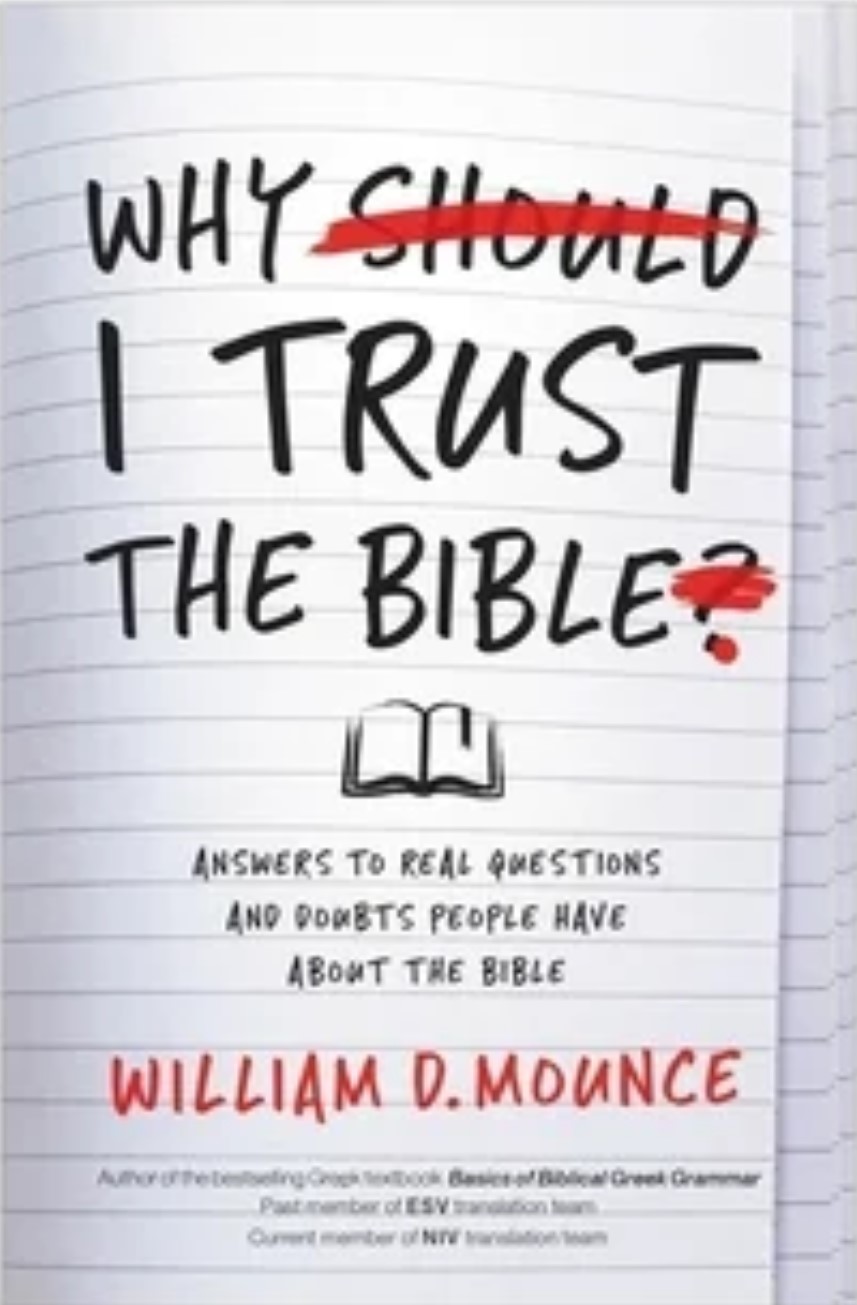
Downloads
Recommended Readings
Links
About BiblicalTraining.org
BiblicalTraining.org wants every Christian to experience a deep and loving relationship with Jesus by understanding the life-changing truths of Scripture. To that end, we provide a high-quality Bible education at three academic levels taught by a wide range of distinguished professors, pastors, authors, and ministry leaders that moves from content to spiritual growth, all at no charge. We are a 501(c)(3) non-profit funded by gifts from our users. We currently have over 180 classes and seminars, 2,300 hours of instruction, registered users from every country in the world, and in the last two years 1.4 million people watched 257 terabytes of videos (11 million lectures).
Our goal is to provide a comprehensive biblical education governed by our Statement of Faith that leads people toward spiritual growth.