Why I Trust My Bible - Lesson 1
Significance of the Question
In this lesson, explore why trusting the Bible is both a rational belief and a matter of faith. Dr. Bill Mounce emphasizes that while it's impossible to prove the Bible’s trustworthiness, there is solid evidence and coherent reasoning to support belief in it. You will journey through key topics such as the historical reliability of Jesus, the accuracy of biblical translations, and the need for sound doctrine. This lesson challenges you to ask critical questions and provides tools to hold firmly to your faith, encourage others, and refute opposing views with confidence in the Bible's reliability.

1. The world is asking (and attacking)
2. Your friends are asking (or they will)
3. You should be asking
4. You must be asking (Titus 1:9)
a. Hold firmly
b. Encourage others by sound doctrine
c. Refute
Why I Trust My Bible
Dr. Mounce
Significance of the Question
1. The World is Asking and Attacking
Well, welcome to this class on Why I Trust My Bible. I’m Bill Mounce. I’ll be your teacher through this class. And I wanted to start with just a few opening kind of comments to orient yourself to me and my own experiences, but also to the class on the issues that we’re going to be raising. I was initially trained as an academic. I taught in college for ten years, and I taught in graduate school, seminary for about four. And what’s interesting about that, is that as an academic, especially as a college teacher, this whole issue of why I trust my Bible was one of those paramount issues that kept coming up in class after class after class. And so, I’ve been talking about this for quite a while. In seminary it was more helping future pastors know how to answer the questions, but college was a very pivotal time for me informing this whole issue and my answers to why I trust my Bible. I moved into the pastorate then, and again as a pastor you have different kinds of questions coming in about trusting your Bible: Is it real? Is it authentic? Did the Biblical writers get the story right? Did the church alter it through the centuries?; you know, a lot of those kinds of questions. And so, I had to deal with this issue as a pastor.
I’ve also been a translator. I was the New Testament chair for the first ten years of the ESV, and I’m currently on the NIV committee. And as a translator, you’re also looking at this: Is this the right word? Will it give someone the wrong idea? Will it make someone believe or not believe the Bible? I mean, these are real issues that translators struggle with. Now I’m president of BiblicalTraining.org and it’s my privilege and my joy to be able to take all these experiences and to produce these series of talks on why I trust my Bible.
Now it’s important you understand the relationship of two different classes on Biblical Training. In one of the other tracks we have one where the words are plural, ‘Why We Trust Our Bible.’ And what we’ve done is that we’ve gone out and gotten some of the world’s experts on these issues. So, Darrell Bock talked about the historical Jesus, Craig Blomberg talks about the reliability of the Bible, and we have other world experts. And that class is talking about much of the same topics I’ll be talking to you about, but in much greater depth. This is, in one sense, almost a summary of what they say with a few of my own things thrown in. But this is more of a lay level basic kind of class on why I trust my Bible. Now the really important thing is that as we’re talking along and you hear a topic and you want to know more, you can always pop over to the other class and hear, and maybe I’ll spend ten minutes on something, but Craig Blomberg may spend a half hour on something. So, the links are on the website, and you can pop over to the other class whenever you want to get more information. So, it’s a real joy to be able to do this.
What I’m going to be doing is taking ten or so basic concepts, basic issues that are being raised, and we’re going to do them chronologically. So, we’re going to start with the historical Jesus--did he really exist--and we’re going to go through the centuries and end up talking about translations and why you can trust translations. So, I picked about ten or so topics that come up in discussions. And again, the overall question is ‘can I trust my Bible?’ Now, here’s a very important point I need to make up front, and I’ll make it repeatedly as we go through the class. Can you prove that the Bible is trustworthy? The answer to that is ‘no.’ You can’t prove, but the fact of matter is you can’t prove anything, not really. You can’t prove the existence of God for a deist. You can’t prove that there is no God for an atheist. You can’t prove evolution or you can’t prove creationism. We have our beliefs on it, but at the end of the day you can’t prove it. And that’s a really important point because if you’re listening to this class and you’re looking for ironclad-proof that beyond a shadow of a doubt you can know that such and such is true, then that’s simply not possible, but it’s not possible for any of life, and it’s just not possible. That’s just the nature of reality. At the end of the day all belief systems are precisely that. They’re belief systems. They’re faith systems.
So, if you set the bar so high, say I’m going to set it really high, and if I can get my arguments together and get it to this point, I can prove, I can prove that the church didn’t alter the message of Jesus, well, the bar is so high you’re never going to get up to it. Of course, if you set the bar too low, then you’re not going to be able to convince anyone that it’s true. So, on this whole question of ‘can I prove the Bible is trustworthy?’ The answer is no. But here’s the other flip side of that coin. Is it a rational belief? And the answer, I believe, is yes. In other words, I don’t have to put my brain on a shelf to be a Christian. I don’t have to put my brain on a shelf to believe the Bible is trustworthy. There’s good evidence. There’s good argumentation. It’s an internally consistent and coherent argument. It is, I believe, the most rational thing you can do is to believe that the Bible is trustworthy. Can I prove it? No! But can I create a cogent rational argument that holds together? Yes, I believe we can. And so, you just need to be aware of those two different things.
The other thing that I wanted to stress is this class is going to be pretty basic. The class elsewhere, the ‘Why We Trust Our Bible’ is going to get a little more technical, and at times it might go. . . just a little hard to follow. Well, what I want you to do is I want you to be able to leave this class with the assurance that even if you don’t fully understand some of these arguments, there are conservative evangelical scholars that have spent their life studying these issues. And they believe the Bible is trustworthy, and I think that’s encouraging to people as well. So, proof, rational, that whole issue, it’s important to state upfront.
The other thing I wanted to say just as kind of a housekeeping chore is that I’ll be referencing some YouTube videos and some handouts and things like that. All of those links are in the online class. So, if you want to watch a YouTube video to have some guy say that Jesus didn’t exist, the links will all be there and you’ll be able to follow them.
This is, on this whole topic of the historical reliability of the Bible, is an incredibly significant question. I got to go to South Africa several months ago, and I taught in two different school settings on the Pastorals. And we had expected turnouts, you know, they were good, it was a good experience. But then one night my host said, and I was teaching with someone else as well, the host said, “Hey, let’s open a Sunday night. . .(Wednesday night I think it was) session just to the area and this whole issue of can I trust my Bible.” Hundreds of people showed up, and the point of the illustration is that this is a real viable question, and people all around the world are asking it. So, I think it’s really important that you be aware of how significant this issue is. There are people out there–and again the links are on the website–who simply have gone on television saying, “We don’t think Jesus ever existed; he’s a totally mythical person.” Wouldn’t it be absolutely amazing if the single most important person in the history of the world, I mean whether you believe he’s God or not, whether you believe he’s the Way, the Truth, the Life, or not is not the point. He is, and I don’t think. . . I don’t see how anybody can argue this, the single most influential person, force, in the history of world. Wouldn’t it be amazing if he never really lived?
2. Your Friends are Asking
But the people are really attacking this whole thing. You know, it used to be when I was younger, there would be this whole issue of that most of us accepted a Judeo-Christian worldview, even non-Christians. That’s all gone. That day doesn’t exist any longer, at least in America; certainly not in western culture.
And the world is not going to give us the benefit of the doubt. It’s going to attack. And so, you need to know the answers to these questions. Your friends are going to be asking you, or they will be asking you, as you live as salt and light in a dark world. People are going to ask you, “Why?” And you need to have an answer to that. But not just that, I think you should be asking the question. I know in certain parts of evangelical Christianity the idea of asking basic fundamental questions is frowned upon. It’s not a good thing. “Oh, you shouldn’t be asking those questions. You know. . . Is Jesus really God? Is salvation really by faith? Is the Bible really from God? Is it a trustworthy guide to all that we believe and do and say?” And I want to give you the exact opposite answer. It is critical that you are asking these questions. It is absolutely critical. Let’s say that you were raised in a Christian home. And, if you ask a six or seven-year-old, “Now Billy, do you believe that this is true, do you believe the Bible is true?” Well, as a six or seven-year-old I would have said “Sure.” And if somebody said, “Why?” I said, “Oh, my mom and dad told me it was true.” Maybe I would have been ten, but I was a kid. And that’s a great answer for a six/seven-year-old, and the reliability of the messenger is all tied up with the reliability of the message. That’s a biblical concept. And so the fact that your mom and dad told you it’s true and you trust them, that’s a great answer for a six-year-old. It’s a terrible answer for a freshman in college, and yet that was what I heard more than anything else. . .”Why do you believe the Bible is true?” “Well, my parents told me it was true.” I look at these seventeen/eighteen-year-olds. And I go, “Do you believe everything your mommy says?” Of course, the answer is “No, I’m in the process of becoming an adult. I’m in the process of taking the beliefs that I was taught and trying to decide for myself whether I really think they’re true or not.” That’s fantastic!
And you need to hear that. That is fantastic! Because here’s why. If you don’t go through the process of honestly asking, “Do I really believe this?” Then you never really will believe it. That’s critical that you understand that. And this is why this questioning process is such a good thing. You’re not questioning, well, I was going to say you’re not questioning God, but that’s not the point. The point is that you have to go through the process of saying “Ok, when I was a little kid I believed it for such and such reasons, but I’m becoming an adult, or I am an adult, and I need to decide whether this is true for myself.” And that’s why this class is so important.
3. You Should Be Asking
I do want to walk you through the major challenges to believing the Bible is trustworthy, and I want you to start making those processes for your own, because the fact of the matter is you will keep making this decision. It’s a cycle that you may decide in college that “Yes, I believe the Bible is trustworthy.” Then you get out in life, you start your career, you get married, you have a couple of children, and like what happened to us, your first child will die. And you're sitting there at the funeral and you’re asking yourself how can a good God let this happen? How on earth can a good God, all powerful God, let this happen? Do I really trust Him? Do I really believe His word? See, life will throw curves at all of us. Sometimes the curves are going to be huge. Sometimes they won’t be as big. But all of us have these kinds of issues that come up in our life. And you will go through this cycle, and it will be a good cycle, because when you come out the other side trusting the Bible, even the face of the death of a child, you will realize that you trust it more than you did before the child was born, because you’ve gone through the cycle, and it’s like you’re going deeper and deeper into your soul, and believing it with more and more conviction.
So, I just really encourage you. . .don’t feel like you shouldn’t be asking this question. You really, really should be asking this question. It is absolutely critical.
4. You Must Be Asking
a. Hold Firmly
Paul tells Titus in 1:9, and the issue is about elders, but I think it applies to all Christians. He tells Titus that the elder must hold firmly (that’s the first thing) to the trustworthy message as it has been taught, so that he can encourage others by sound doctrine (that’s the second thing), encourage others, and (thirdly), refute those who oppose it. Ok, that’s absolutely critical. What that means is that you and I (a) have to hold firmly to the Bible. That means we have to know it. That’s why we have biblical training so that you can get your biblical and theological education here. You have to know it, and in the course of the experiences of life, you will come to hold firmly to it. You can’t just have an academic study and go, “Yeah, I’m gonna hold firmly to the Bible.” That’s part of the process of learning the Bible and then going through experiences of life, coming out the other side, and you realize you’re grasping onto it even more so than you ever have before. Alright, so you have to hold firmly to the Gospel.
b. Encourage Others
Secondly, you have to be able to encourage others by sound doctrine. Sound doctrine is an important concept in the Pastorals. It’s the idea that the biblical gospel, the biblical doctrine, gives spiritual health. It gives life. It’s sound. It’s rational and it makes sense. It’s life giving. That’s what Paul is saying. Try to translate that. . .it’s pretty hard! But anyway, you are to encourage others by sound doctrine. Now, you and I have ideas. They may or may not be good ideas, maybe they’re really lousy ideas, I don’t know. But we’re going to encourage people with our own ideas. That’s fine. But ultimately the encouragement needs to come from Scripture and that means you need to know it, be convinced that it’s true so that you can then encourage others by it. Just last night we had a couple over whose adult son died under difficult circumstances. And man, are they hurting. I mean they are really, really hurting. And some people may say, “Oh, you know, it’s ok, you’ll get over it,” or some such stupid thing to say. That’s not what we did. We talked about Scripture. We talked about the sovereignty of God, of the fact that God loved their son, that he is now with his Lord and Jesus. And while the parents are hurting, they have a hope in the future. See, that’s encouraging people with sound doctrine, with biblical doctrine, and that’s what you need to be able to do. And boy, if you don’t trust your Bible you’re not going to encourage people by it. Right? You’re not going to do it.
c. Refutation
And then the third is you have to be able to refute those who are opposing Scripture. That’s a little more difficult. I remember reading a survey once that said that the average person, once they’ve been a Christian for five years, has no non-Christian friends. In other words, we tend to cocoon ourselves in the church. Now again, that was probably fifteen years old, and in today’s culture hopefully that’s not the case. But presumably we all have non-Christian friends, and we need to know what they think. We need to know what they are listening to. We need to know the silly things and the damning things that are being said on some of these YouTube videos. Some of these things are just vile. I was listening to one the other day and it was remarkable to me that God just didn’t strike them dead! I mean, it was so bad. But that’s what’s out there. That’s what’s influencing the people around us, and we have to know what’s going on so that we can refute it with the sound doctrine of Scripture because we, through experience and study, are absolutely convinced that it’s true. And there are some links on the class page for this to some places that will kind of help you know what’s going on in our culture.
So, anyway, that’s the significance of the question. And I hope you’re excited. There’s a lot of good stuff coming, and I look forward to walking the rest of this class with you. Thanks!
- Some people feel that it is wrong to ask fundamental questions such as whether or not they trust the Bible. But if you never seriously ask the question, you will never be convinced that it really is true and trustworthy.0% Complete
- Some question whether Jesus actually lived, claiming there's only one non-biblical reference. This is false; there are many more.0% Complete
- Learn about the reliability of the New Testament through oral tradition, the impact of Jewish oral culture, three approaches to orality, memorization techniques, corporate memory, scholarly presuppositions, the Holy Spirit's role, and the delayed documentation of the Gospels.0% Complete
- While the gospels are anonymous, tradition is very strong as to who wrote Matthew, Mark, Luke, and John, and all four authors were in a position to know the truth and we can trust their writings. If the church did not care about authorship traditions, they would not have picked these four.0% Complete
- If the biblical writers were not concerned about historical accuracy, we would expect more verses that would have answered the burning questions of the first century, and we certainly would not have the many embarrassing and difficult verses that we do have. The gospel is couched in historical fact, and if the events did not happen then the teaching is false.0% Complete
- Learn how to address perceived contradictions in the Bible by understanding harmonization, interpretation, and considering possible errors in secular sources, all while encouraging a trust in the Bible’s reliability.0% Complete
- Investigate whether Paul changed Jesus’ message. Despite different contexts and approaches, Jesus' and Paul's teachings align on core theological issues like justification by faith and ritual purity, affirming their compatibility.0% Complete
- Learn why trusting the Bible is rational despite the inability to prove it, and you'll gain tools to ask questions, strengthen your faith, encourage others, and counter opposing views with sound biblical doctrine.0% Complete
It does no good to talk about inspiration and canonization if the church altered the contents of the Bible through the centuries. And why are there differences among the Greek manuscripts? This is the topic of textual criticism. The current situation is that we are confident of 99% of the New Testament text, and the 1% we are unsure of contains no significant theological doctrine.
0% CompleteUnless you can read Greek, Hebrew, and Aramaic, you need a translation. But why are there so many, and why are they so often different? Can they be trusted? Bill Mounce, chair of the ESV translation for 10 years and currently on the Committee on Bible Translation that is responsible for the NIV, shares his answer to these questions.
0% Complete- Dr. Mounce shares personally why he trusts his Bible.0% Complete
Lessons
- Some people feel that it is wrong to ask fundamental questions such as whether or not they trust the Bible. But if you never seriously ask the question, you will never be convinced that it really is true and trustworthy.0% Complete
- Some question whether Jesus actually lived, claiming there's only one non-biblical reference. This is false; there are many more.0% Complete
- Learn about the reliability of the New Testament through oral tradition, the impact of Jewish oral culture, three approaches to orality, memorization techniques, corporate memory, scholarly presuppositions, the Holy Spirit's role, and the delayed documentation of the Gospels.0% Complete
- While the gospels are anonymous, tradition is very strong as to who wrote Matthew, Mark, Luke, and John, and all four authors were in a position to know the truth and we can trust their writings. If the church did not care about authorship traditions, they would not have picked these four.0% Complete
- If the biblical writers were not concerned about historical accuracy, we would expect more verses that would have answered the burning questions of the first century, and we certainly would not have the many embarrassing and difficult verses that we do have. The gospel is couched in historical fact, and if the events did not happen then the teaching is false.0% Complete
- Learn how to address perceived contradictions in the Bible by understanding harmonization, interpretation, and considering possible errors in secular sources, all while encouraging a trust in the Bible’s reliability.0% Complete
- Investigate whether Paul changed Jesus’ message. Despite different contexts and approaches, Jesus' and Paul's teachings align on core theological issues like justification by faith and ritual purity, affirming their compatibility.0% Complete
- Learn why trusting the Bible is rational despite the inability to prove it, and you'll gain tools to ask questions, strengthen your faith, encourage others, and counter opposing views with sound biblical doctrine.0% Complete
It does no good to talk about inspiration and canonization if the church altered the contents of the Bible through the centuries. And why are there differences among the Greek manuscripts? This is the topic of textual criticism. The current situation is that we are confident of 99% of the New Testament text, and the 1% we are unsure of contains no significant theological doctrine.
0% CompleteUnless you can read Greek, Hebrew, and Aramaic, you need a translation. But why are there so many, and why are they so often different? Can they be trusted? Bill Mounce, chair of the ESV translation for 10 years and currently on the Committee on Bible Translation that is responsible for the NIV, shares his answer to these questions.
0% Complete- Dr. Mounce shares personally why he trusts his Bible.0% Complete
Class Resources
Recommended Books
Why I Trust My Bible - Student Guide
We can no longer assume that people trust their Bible. The popular media has launched such an attack on the believability of Scripture that our people have serious questions...

Why I Trust The Bible
Answers to Real Questions and Doubts People Have about the Bible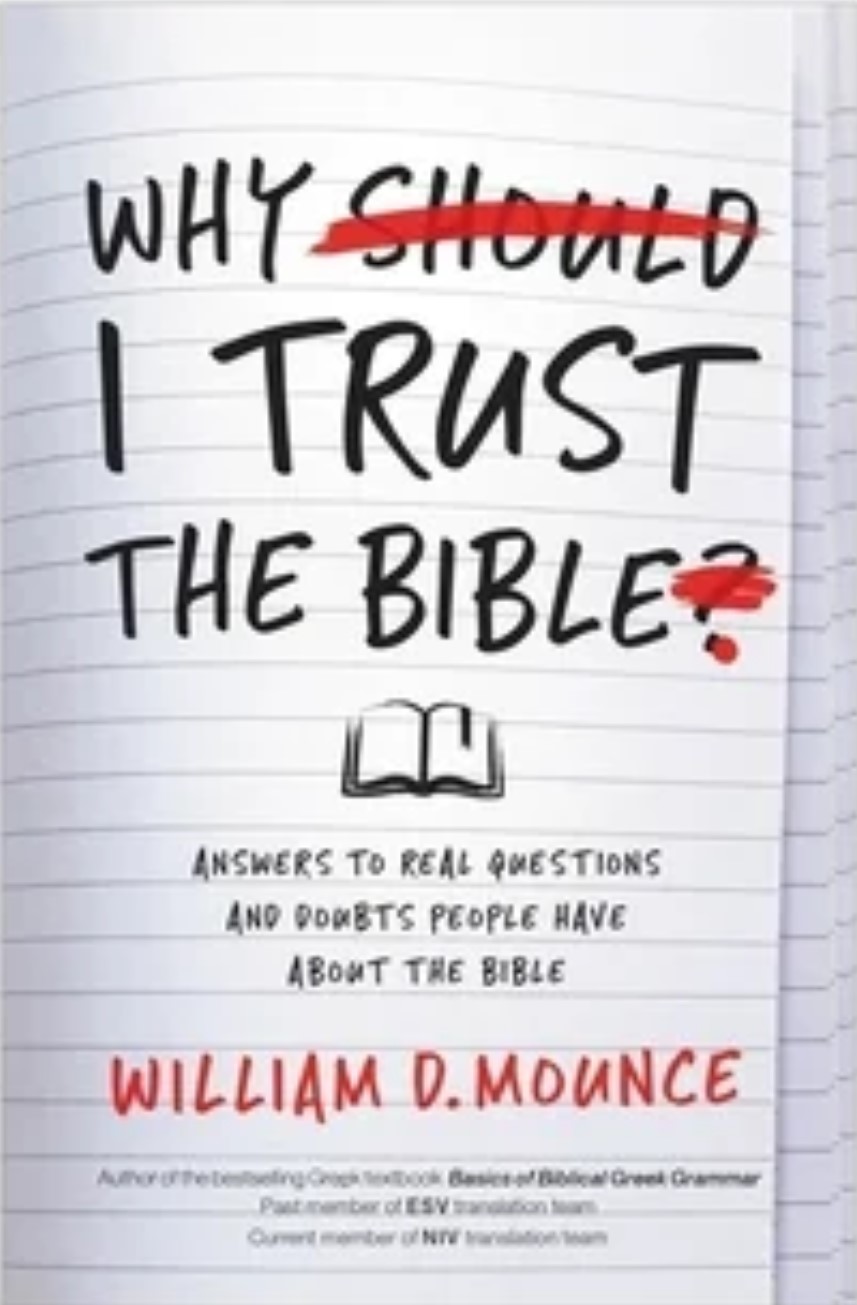
Downloads
Recommended Readings
Links
About BiblicalTraining.org
BiblicalTraining.org wants every Christian to experience a deep and loving relationship with Jesus by understanding the life-changing truths of Scripture. To that end, we provide a high-quality Bible education at three academic levels taught by a wide range of distinguished professors, pastors, authors, and ministry leaders that moves from content to spiritual growth, all at no charge. We are a 501(c)(3) non-profit funded by gifts from our users. We currently have over 180 classes and seminars, 2,300 hours of instruction, registered users from every country in the world, and in the last two years 1.4 million people watched 257 terabytes of videos (11 million lectures).
Our goal is to provide a comprehensive biblical education governed by our Statement of Faith that leads people toward spiritual growth.