Essentials of Old Testament Theology - Lesson 5
The Heart of God in Judgment
Explore Exodus 34 to understand God's character in judgment. The lesson highlights judgment's rarity in modern Christianity compared to the early Church. Key references include Acts 10, 2 Timothy 4, and 2 Peter 3. God's balance of mercy and accountability is examined through passages in Deuteronomy, Hosea, Joel, Jonah, and Nahum, focusing on repentance and intercession. The lesson concludes with Lamentations, emphasizing the harsh reality of judgment and the hope in God's mercy through reconciliation in Jesus Christ.

I. God's Character & Judgment: The Law
A. God assesses, grieves, & punishes by specific act (Gen 1–10)
B. God forgives the penitent & holds the rebellious accountable (Ex 34:6-7)
C. God promises to judge Israel (Lev 26; Dt 27–28)
II. God's Warnings & Judgment: The Prophets
A. God desires repentance, not destruction (Hosea 6:1-3; 9:5; 11:1-9; 14:1-9)
B. Repentance stays judgment (Joel 2: 12-14)
C. Intercession may stay judgment (Joel 2:12-14)
D. Repentance stays judgment for Jew & Gentile (Jonah 3: 10; 4:1-2)
E. Lack of repentance leads to judgment for Jew & Gentile (Nahum 1:1-8; Zeph)
III. God's Action & the Terrible Reality of Judgment: The Writings
A. Judgment is horrible (Lam 1-2; see Dt 28, Lev 26)
B. Judgment is merited, or it does not occur (Lam 1–2)
C. Judgment does not come from God’s heart, his faithfulness endures forever, & the Lord is good (Lam 3:19-39)
Open your Bibles to Exodus 34. I want to talk about the heart of God in judgment in the Old Testament. I’m reminded that in Christianity these days—I don’t know so much in our church or in other good churches—but in general, judgment is rarely on our agenda. We don’t speak of it much, but the early church certainly had judgment as a theme on its agenda.
As you have Exodus 34 there, I’m reminded of a couple passages in the early church’s preaching, like Acts 10:42 and 10:43. In a sermon which Peter is preaching, he says, “And he commanded us to preach to the people and to testify that he…” Jesus, “…is the one appointed by God to be judge of the living and the dead. To him, all the prophets bear witness that everyone who believes in him receives forgiveness of sins through his name.” It’s interesting to me thinking tonight about what I heard Kent preach so effectively Sunday morning from 2 Timothy 4:8. Paul’s talking about his future and he says, “Henceforth there is laid up for me the crown of righteousness which the Lord, the righteous judge, will award to me on that day…” Paul’s anticipating meeting his judge. In a passage like 2 Peter 3—it’s a long passage and I won’t read all of it. But he says starting in verse 10, “But the day of the Lord will come like a thief, and then the heavens will pass away with a roar, and the heavenly bodies will be burned up and dissolved, and the earth and the works that are done on it will be exposed. Since all these things are thus to be dissolved, what sort of people ought you to be in lives of holiness and godliness…” (2 Peter 3:10–11).
I started thinking about passages like this partly because of two academic assignments, one of which was to write a commentary on the book of Lamentations. These are the results of judgments of God’s people enduring the day of the Lord as he promised them, that if long term ingrained sin continued, God would judge Israel, and indeed he did. Then I started also thinking about passages like 2 Peter 3:10–11, above, because of some writing I’ve been doing on the minor prophets who talk repeatedly about the Day of the Lord. The New Testament talks about judgment in the same way about the Day of the Lord.
So, it’s important for us to put judgment on our agenda. I want us to study just a few basic elements of it tonight so that when you read those New Testament passages like Acts 10 and 2 Peter 3 and say, Timothy 4, you might have some idea of what they mean when they say, “on that day” because there was a term (Day of the Lord) that denoted something from the Old Testament.
So, we’ll start with God’s character in judgment in the Law, then go to God’s warnings and judgment in the Prophets, and finish with God’s action and the terrible reality of judgment in the Writings, so God’s character in judgment. Thus, we started with Exodus 34.
I. God’s Character & Judgment: The Law
You may recall that Israel has received the initial installment of God’s covenant. They’ve promised to keep it. And yet, while Moses is gone, they make and worship the golden calf. You remember all this and how this creates a terrible breach in their relationship with God and God acts to judge them. Moses prays and intercedes, and God renews the covenant. As part of that, he reveals his character in Exodus 34:6–7, “The Lord passed before him,” that is Moses, “and proclaimed, ‘The Lord, the Lord, a God merciful and gracious, slow to anger, and abounding in steadfast love and faithfulness, keeping steadfast love for thousands, forgiving iniquity and transgression and sin, but who will by no means clear the guilty, visiting the iniquity of the fathers on the children and the children’s children, to the third and fourth generation.’” Which is to say he will be as thorough in judgment as he is in blessing, if need be. This is picturesque language to the thousands and to the generations.
Then, the nature of God here is set forth very clearly. God forgives the penitent and holds the rebellious accountable all at the same time. But we need to notice that his mercy is primary. What is set forth here is that the Lord is a God who is merciful and gracious and slow to anger and abounding in steadfast love and faithfulness. And he forgives. Forgiveness is his primary, his first impulse. Yet his mercy is primary, it’s not solitary. It’s not by itself; that isn’t all there is. He says, I will by no means clear the guilty. He might as well throw in I will not ask you the timing and how to meet that out. He is yet to ask my opinion on how fast he ought to judge people. I often offer my opinion. He is interested, but he is not moved by it. He has a better plan. But this is his basic character.
If you turn to Deuteronomy 27 and 28, particularly chapter 28—it’s like Leviticus 26 passages in which God promises to bless Israel beyond their wildest dreams, giving them all their needs, taking care of them, giving them security. He does not say there will always be wealth and joy, but he says, I will meet your needs and I will care for you. I will do all these things as you serve me. Then in Deuteronomy 28:45, this warning comes that if indeed they continue to sin over a period of time, “All these curses,” or ‘consequences,’ “shall come upon you and pursue you and overtake you till you are destroyed because you did not obey the voice of the Lord your God, to keep his commandments and his statutes that he commanded you.” How bad will it be? In Deuteronomy 28:52—this speaks of ancient warfare. It sounds rather brutal to us, but you’ve seen what modern warfare looks like in the Sudan. We hope and pray that we won’t see more of what modern warfare looks like in the Persian Gulf. So, I’m not sure we should be superior in our mindset.
But in verse 52–53, “They shall besiege you…” That is, they’ll set siege to your towns. They’ll cut off all the food and water coming in:
until your high and fortified walls, in which you trusted, come down throughout all your land. And they shall besiege you in all your towns throughout all your land, which the Lord has given you. And you shall eat the fruit of your womb, the flesh of your sons and daughters, whom the Lord your God has given you, in the siege and in the distress with which your enemies shall distress you.
And it goes on. One of the ways God brings judgment is to turn us over to our own ways throughout their history. And it is an uneven history that has some glorious ties. But after a while, Israel finally decides they would rather have alliances with other nations and follow the ways of other nations and the religions of the other nations rather than what God had revealed to them. God eventually says, I will turn you over to those nations. Eventually and again, God’s timing is known by God alone. I don’t have a one, two, three, four step that says if you’re at step three and a half, God’s about to turn you over. I don’t have such a clock or a timetable for nations either. But it’s clear in the Scriptures that as nations, particularly the nation of Israel, but other nations as well—as they continue to turn away from the Lord, eventually the Lord will give them over to their choices.
That may be the worst judgment of all. Do you remember what David said when God offered him two possible punishments? You’ll either suffer at my hands, or I’ll turn you over to your enemies. David’s response was, don’t turn me over to my enemies! There’s mercy with the Lord, but not with human beings. And surely, we can see the truth of that. But as God’s own people chose these other nations the prophets say, you chose those lovers. God gave them over to those relationships. It was a terrible thing. A friend of mine said one of the scariest phrases in the Bible is “God gave them over,” whether it’s to a reprobate mind or to their choices or whatever else. God’s mercy is such that he doesn’t give us over. He gives us his word; he gives us one another. He gives us the truth. God’s character is primarily to be merciful, but he will not clear the guilty.
II. God’s Warnings & Judgment: The Prophets
God’s warnings and judgments in the prophets—remember Exodus 34, because we’re going to hear these phrases again—but turn to the book of Hosea in chapter 6. If you know anything about the book of Hosea, you know that God compares how Israel is treating him with Hosea’s terrible marriage—a wife who’s gone astray and committed adultery. That’s a horrible thing. It’s a horrible comparison. The prophet says in Hosea 6:1–3, “Come, let us return to the Lord; for he has torn us, that he may heal us; he has struck us down, and he will bind us up. After two days he will revive us; on the third day he will raise us up, that we may live before him. Let us know; let us press on to know the Lord; his going out is sure as the dawn; he will come to us as the showers, as the spring rains that water the earth.”
Hosea has two or three other passages that are relevant in Hosea, but he makes it very clear: God desires repentance, and repentance will always stay judgment. It’s a biblical principle. I’m going to say it now: Sometimes intercession stays judgment. You read of Amos praying for the people and God waits to send judgment. You read of intercession, but repentance stays judgment. Look at Joel 2:12, just a few pages over in your Bible. See if it starts to sound familiar to you. Having stated they need to pray and fast, they need to change their attitude toward their behavior, it says in verse 12, “’Yet even now,’ declares the Lord, ’return to me with all your heart.’” Yet even now—if “he gave them over” are some of the saddest words in the Bible, maybe some of the best news we have is “Yet even now…return to me with all your heart, with fasting, with weeping, and with mourning; and rend your hearts and not your garments” (Joel 2:12–13). In the whole of the Bible, the testimony is that a relationship with God begins in the heart. Return to the Lord your God, for he is gracious and merciful, slow to anger and abounding in steadfast love.
And he relents over disaster. That is, God has every right to tell us that judgment is on the way and will come if there is no repentance. When repentance comes, God indeed does not send that judgment, that disaster. Repentance always stays judgment. And so, “Who knows whether he will not turn and relent, and leave a blessing behind him, a grain offering and a drink offering for the Lord your God?” (Joel 2:14). It’s in God’s hands when we return. It’s in God’s hands when we repent, when we turn away from doing what is wrong and return to the Lord. Repentance stays judgment. Intercession may stay judgment.
Now, let’s go on to Jonah 3:10, if you would. The text says that Nineveh repents at Jonah’s word. In verse 9, the king of Nineveh says, “Who knows? God may turn and relent and turn from his fierce anger so that we may not perish.” In verse 10 it says, “When God saw what they did, how they turned from the evil way, God relented of the disaster that he had said he would do to them, and he did not do it.” This displeased Jonah exceedingly. The text doesn’t tell us why. And as I said to the men’s Bible study a few Friday mornings ago, I’m kind of glad God didn’t because I’ve heard some teaching saying Jonah was a racist. Some of us would say, if we’re not a racist, well, then we can excuse ourselves. No, it leaves it open. So, for whatever reason, you would have to be displeased that these Ninevites, these Assyrians were repenting—he was angry, “And he prayed to the Lord and said, ‘Oh Lord, is not this what I said when I was yet in my country? That is why I made haste to flee to Tarshish; for I knew that you are a gracious God and merciful, slow to anger and abounding in steadfast love, and relenting from disaster’” (Jonah 4:2).
Joel knew it. Hosea knew it because Exodus taught it. This is the nature of God. This is nature of God. The good news is, if Nineveh can repent and if God can forgive, then who really is outside the possibility of the grace of God? Who’s outside that scope? No one. And he turns from the disaster.
On the other hand, one more passage is going to sound these same words. The book of Nahum 1:2—Nahum was written something over 100 years later in a letter that relates to the same city, Nineveh. Nahum says, “The Lord is a jealous and avenging God; the Lord is avenging and wrathful; the Lord takes vengeance on his adversaries and keeps wrath for his enemies. In verse three it says, “The Lord is slow to anger great in power, and the Lord will by no means clear the guilty.” That’s Exodus 34 again. It goes on to say in verse six, “Who can stand before his indignation? Who can endure the heat of his anger?” God’s primary impulse is to forgive. Jonah shows that repentance, even from the grossest of sinners. This merely shows, as Paul says in 1 Timothy, the greatness of God’s patience and kindness and forgiveness. But for those who are God’s enemies and as human beings do not know what God’s timetable might be—those who do not fear the fact that God will not clear the guilty, lack of repentance leads to judgment. Just as repentance led to forgiveness for Jew and Gentile both, and for Jonah, lack of repentance leads to judgment for Jew and Gentile, like in the book of Nahum. We see God’s warnings and judgment in the prophets. Of course there are other texts, but the prophets preached so that repentance might occur.
III. God’s Action & the Terrible Reality of Judgment: The Writings
I am told that in the book of Jeremiah, the longest book in the Bible by word count, that over something like 111 times Jeremiah used some form of the word ‘repentance.’ By the end of the book, when you see that he’s garnered at least two converts in 40 years, at least the message went out. The offer of grace went out. But now here’s a sobering thing, and I guess it’s not a real “upper” in the middle of the week—I want to end with Lamentations, God’s action, the terrible reality of judgment.
And I guess this is something that I’ve needed to consider. When I think of how one should cry because of what the king of Syria was going to do to his people, or how Jesus, when he thought about Jerusalem and wept over them, knowing that in 70 AD, that city would be taken to the ground and terrible things would happen. And sometimes I get tired of hearing Jeremiah called “the weeping prophet” as if all he did was sit around and use up a box of Kleenex an hour. It wasn’t just because he had two converts in 40 years. I think I’ve read the book enough, I may have identified a third convert. I’m that hopeful. He knew what the Lord was going to do as he turned the people over to the Babylonians, as they did not trust God.
In Lamentations 1:17, for instance, “Zion stretches out her hands, but there is none to comfort her; the Lord has commanded against Jacob that his neighbors should be his foes; Jerusalem has become a filthy thing among them.” Then in Lamentations 2:2 the author writes, “The Lord has swallowed up without mercy all the habitations of Jacob; in his wrath he has broken down the strongholds of the daughter of Judah; he has brought down to the ground and dishonor the kingdom and its rulers.” How about some specifics in 4:1, “How the gold has grown dim, how the pure gold is changed! The holy stones lie scattered at the head of every street. The precious sons of Zion, worth their weight in fine gold, how they are regarded as earthen pots, the work of a potter’s hands!” What about the mothers? Continuing in verse 3, “Even jackals offer the breast; they nurse their young; but the daughter of my people has become cruel, like ostriches in the wilderness.” They were believed to leave their eggs. In verses 4 and 5, “The tug of the nursing infant sticks to the roof of its mouth for thirst; the children beg for food, but no one gives it to them. Those who once feasted on delicacies perish in the streets; those who were brought up in purple embrace ash heaps.” And it goes on. In verse 9, “Happier were the victims of the sword than the victims of hunger…” All throughout strategic places, the text shows us that this is, indeed, the Day of the Lord that is threatened. No repentance came. “The prophets lied,” the text says, as to the notion that the enemy would never come. The false prophets lied. Judgment is horrible, and when God judges, judgment is always merited.
I always thought I had a low view of the human race. I think as I get older, I get more hopeful about people. I didn’t know that was supposed to happen to me. I tend to think folks make mistakes and I forget we are sinners and we are dead in sin and outside of Jesus Christ, we are his enemies and we do not serve him. We are so desperately in need of salvation and redemption and reconciliation with our maker that we can’t even express it adequately. Only God can express it adequately through the gift of his son. I forget that. And whatever punishment that I would ever receive or that God would ever send on anyone is always merited. Sure, sometimes, and in this text, it’s clear: others can suffer for our sins. We saw a lot of that tonight in the presentation on the Sudan. There’s a lot of people innocently suffering for the sins of others. But when we are judged, which is a different thing, we always merit that.
Let’s go back to God’s heart, chapter 3 of Lamentations. Having stated that the people have merited their judgment—as one who is among the people who’ve seen affliction with them, who’s lived among them, he prays in 3:19–21, “Remember my affliction and my wanderings, the wormwood in the gall! My soul continually remembers it and is bowed down within me. But this I call to mind, and therefore I have hope.”
He had just said in verse 18 his hope had disappeared. When hope is gone, what brings hope back? The steadfast love of the Lord never ceases. God’s covenant mercies cannot come to an end. There are some things that God cannot do because they’re against his character and his mercy can never come to an end. They’re new every morning, and I just think for every one of us, they’re new every morning. There is hope for those who would turn to the Lord because “great is your faithfulness” (Lamentations 3:23b). This word is always used for God’s faithfulness. It’s interesting [inaudible] it’s the faithfulness God gives us as we believe in him. Extraordinary thing. In verse 24, is a phrase that’s used of the Levites, the tribe set aside for the Lord, the one not given a piece of the Promised Land: “‘The Lord is my portion’ says my soul, ‘therefore, I will hope in him.’”
Some of you know quite well there are days where that is all there is, and that is all that is needed to be able to say, “The Lord is my portion.” In my past I’ve heard testimony, not only from missionaries from Sudan, but also from people from the Sudan who said, “If the Lord is our portion, it is sufficient.” I tend to think that sort of thing if money’s tight or something when all there is is the Lord.
In verse 25, “The Lord is good to those who wait for him, to the soul who seeks him.” Then down to verse 31–32, “For the Lord will not cast off forever, for though he cause grief, he will have compassion according to the abundance of his steadfast love.” This is the steadfast love we saw in verse 22. Verse 33 is critical, which we mentioned a couple weeks ago, “For he [God] does not afflict from his heart.” What’s that? What’s the heart of God in judgment? He does not afflict from his heart. That is not his first impulse. As Isaiah says, this is God’s strange act. “He does not afflict from his heart or grieve the children of men” (Lamentations 3:33).
So, when we think about judgment and the terrible reality of judgment, it is horrible. When it comes, it is merited, whether it’s in this life or the next. But even as we look at the results in some of the people who lived through the judgment of God in the book of Lamentations, the hope is not gone because God’s mercy is not gone. His faithfulness is not gone. Him being our portion is not gone, and he never judged from his heart in the first place. But he is willing to judge because he cannot and will not clear the guilty; he will not.
So, there must be reconciliation to himself. As we know in the wholeness of biblical theology through Jesus Christ, that redemption can come. This is one reason we go to the ends of the earth and why we support missions, right? Judgment’s real. People will stand before God and give an account for what they’ve done in this body, whether it’s good or bad. Revelation portrays a great white throne of judgment, and the nations will stand before God.
Well, I don’t know if my heart can take it. I’m not anxious for Kent now to start a topical series on judgment that lasts as long or, say, preach through Luke or something. But if you preach through Luke as he did, you see all those times Jesus and John the Baptist in the early church said “the kingdom of God is at hand.” Judgment has come. “Repent and believe the gospel.” He’s trying to scare people into heaven. I don’t know that I can scare anybody into the kingdom, but I think, at least for those of us tonight who are believers, we should understand and shudder to think that anyone would face a judgment of God. And for ourselves, we ought to say what we read what Paul said in 2 Timothy 4:8. Because of Jesus Christ, I’m ready for that day. And we ought to be able to say with Peter, what sort of people that we ought to be? And then at one place, as you say, if judgments begin at the house of God, what will it be like for all the rest?
So, I guess at the risk of ending a series on a downer, I just really want to say it’s altered my thinking. [Inaudible] I thought I would study these laments and think about prayer and deep-seated seeking God. You read the book and you realize this is a report of survivors of the Day of the Lord. Every one of them would say to us, “Don’t go there, don’t go there. If you have gone there, remember, the heart of God is faithfulness, is loving kindness, is mercy. Go there.”
- Learn the significance of the Old Testament for its historical context, ethical teachings, and prophetic promises, and understand its continuous relevance in Christian life through the perspectives of Jesus and Paul.0% Complete
- Explore four major themes related to God and creation: God's person as the powerful, singular Creator; creation's role in comforting suffering people; the importance of worshiping God as Creator; and creation's connection to wisdom for daily living.0% Complete
- Discover God's personal relationship with his people, his redemption from sin, covenant promises, the Mosaic Law's importance, forgiveness, and the future hope in his eternal kingdom, highlighting his comprehensive care and guidance for humanity.0% Complete
- Learn about the Old Testament's theological themes, including God's role as Creator and Redeemer, the concept of the Messiah, key scriptural passages, and how Jesus fulfills these roles, emphasizing God's plan for salvation and glory to reach all nations.0% Complete
- Discover the profound themes of mercy and judgment in Exodus 34. This lesson includes insights from Acts 10, 2 Timothy 4, and 2 Peter 3. Study passages from Deuteronomy, Hosea, Joel, Jonah, and Nahum, emphasizing repentance and intercession.0% Complete
Lessons
- Learn the significance of the Old Testament for its historical context, ethical teachings, and prophetic promises, and understand its continuous relevance in Christian life through the perspectives of Jesus and Paul.0% Complete
- Explore four major themes related to God and creation: God's person as the powerful, singular Creator; creation's role in comforting suffering people; the importance of worshiping God as Creator; and creation's connection to wisdom for daily living.0% Complete
- Discover God's personal relationship with his people, his redemption from sin, covenant promises, the Mosaic Law's importance, forgiveness, and the future hope in his eternal kingdom, highlighting his comprehensive care and guidance for humanity.0% Complete
- Learn about the Old Testament's theological themes, including God's role as Creator and Redeemer, the concept of the Messiah, key scriptural passages, and how Jesus fulfills these roles, emphasizing God's plan for salvation and glory to reach all nations.0% Complete
- Discover the profound themes of mercy and judgment in Exodus 34. This lesson includes insights from Acts 10, 2 Timothy 4, and 2 Peter 3. Study passages from Deuteronomy, Hosea, Joel, Jonah, and Nahum, emphasizing repentance and intercession.0% Complete
Class Resources
Recommended Books
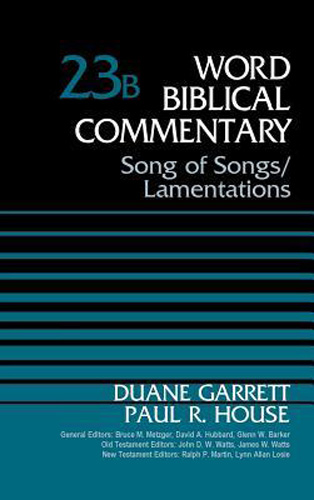
Song of Songs and Lamentations, Volume 23B
The Word Biblical Commentary delivers the best in biblical scholarship, from the leading scholars of our day who share a commitment to Scripture as divine revelation. This...
About BiblicalTraining.org
BiblicalTraining.org wants every Christian to experience a deep and loving relationship with Jesus by understanding the life-changing truths of Scripture. To that end, we provide a high-quality Bible education at three academic levels taught by a wide range of distinguished professors, pastors, authors, and ministry leaders that moves from content to spiritual growth, all at no charge. We are a 501(c)(3) non-profit funded by gifts from our users. We currently have over 180 classes and seminars, 2,300 hours of instruction, registered users from every country in the world, and in the last two years 1.4 million people watched 257 terabytes of videos (11 million lectures).
Our goal is to provide a comprehensive biblical education governed by our Statement of Faith that leads people toward spiritual growth.